
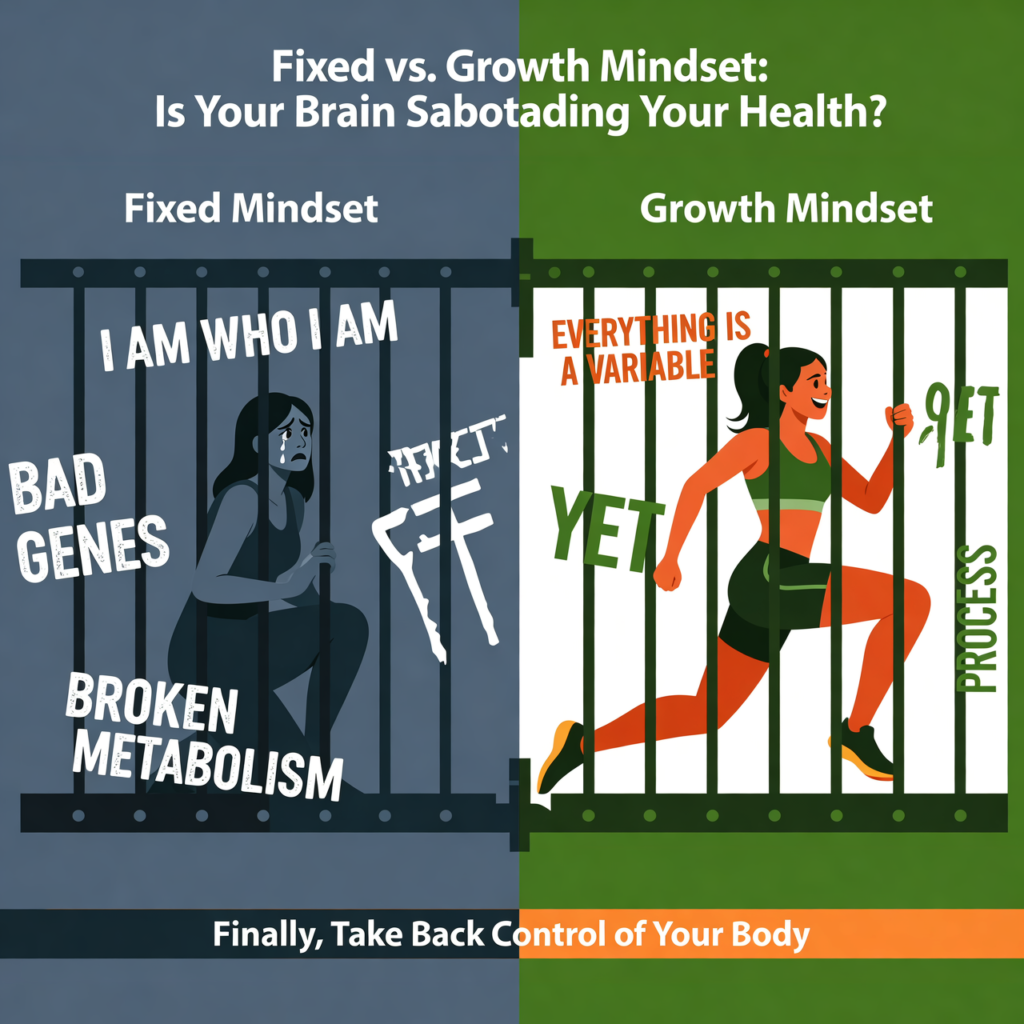
Decisions shape your health, but what shapes your decisions? Explore the real impact of fixed vs. growth mindset on your fitness goals and learn how to finally take back control of your body.
You make hundreds of choices every day. You decide when to eat, how to move, and when to finally put the phone down. But most of those decisions aren’t actually yours. They belong to a “mental script” running in the background of your brain.
If you feel like you’re constantly fighting your own body, you likely have a fixed vs. growth mindset battle happening inside your head. One of these is keeping you stuck in a loop of “good enough.” The other is the key to finally hitting your goals.
The “I Am Who I Am” Trap (Fixed Mindset)
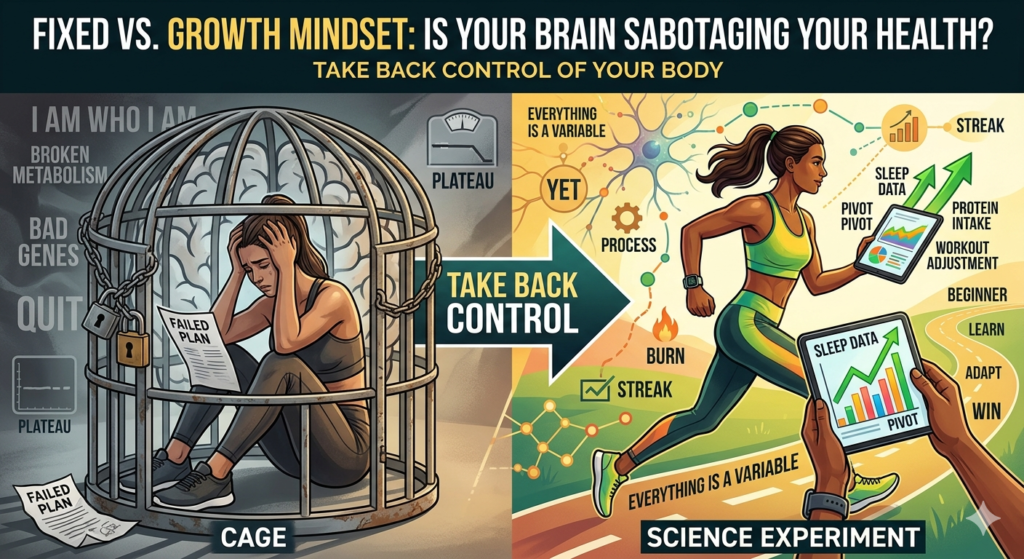
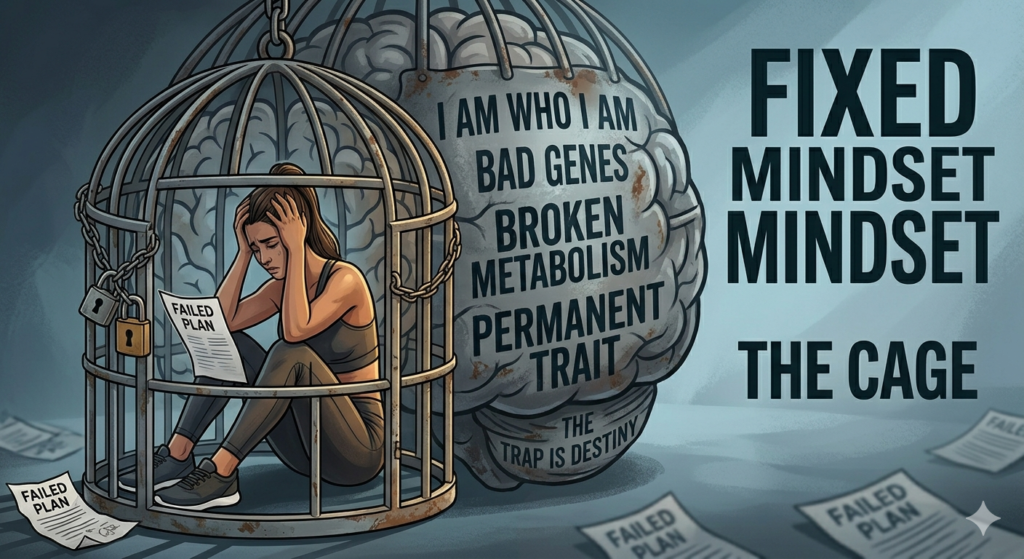
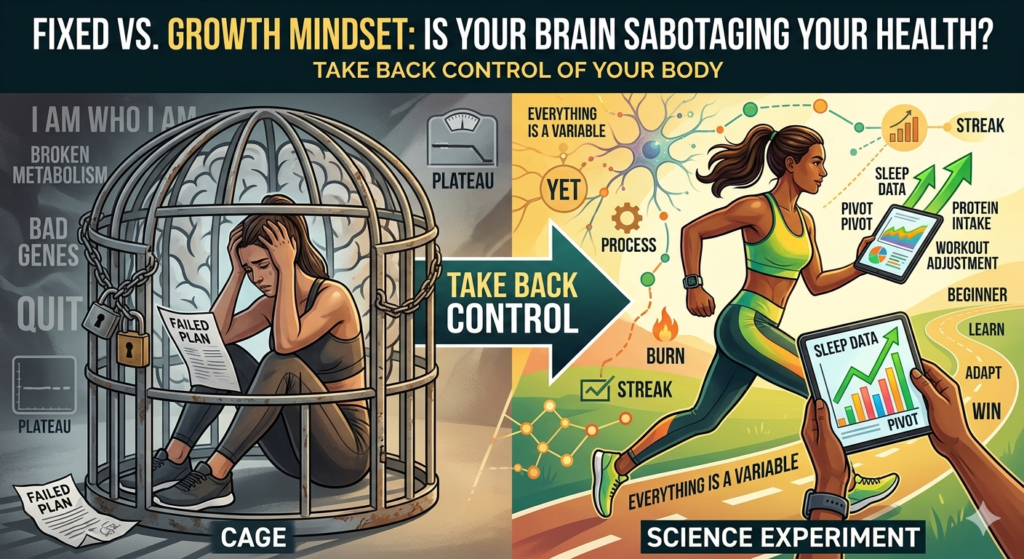
A fixed mindset is a cage. It’s the belief that your metabolism is a set number, your “bad back” is a permanent personality trait, and your cravings are just your destiny.
When you hit a weight loss plateau, the fixed mindset doesn’t look for a solution. It looks for an exit. It says, “See? I knew I couldn’t do this. This is just how my body is built.” It turns a temporary hurdle into a lifetime sentence.
The “Everything is a Variable” Strategy (Growth Mindset)
A growth mindset treats your body like a science experiment, not a static object. Most people view their health as a “pass/fail” exam. If the scale goes up, they’ve failed. If they miss a workout, they’re lazy. This is a dead end.
When you shift to a growth mindset, you stop being the defendant and start being the lead researcher. If your energy levels tank or the scale stops moving, you don’t take it personally. You don’t beat yourself up or claim you have “bad luck.” You look at the data. You become a detective in your own life.
You start asking the hard, objective questions:
- “Is my sleep quality actually deep, or am I just in bed for 8 hours?”
- “Am I hitting my protein floor to protect my muscle mass?”
- “Has my body adapted to this specific workout intensity?”
- “Is my daily movement (NEAT) dropping because I’m tired?”
In this mindset, a failure isn’t a “sign” to quit or a verdict on your worth. It is a signal to pivot.
If a scientist runs an experiment and it doesn’t work, they don’t burn the lab down. They change one variable—maybe it’s more water, maybe it’s less stress, maybe it’s more heavy lifting—and they go again. This removes the emotion and replaces it with execution. You aren’t “broken”; you just haven’t found the right configuration yet.
3 Signs Your Mindset is Secretly Controlling Your Health
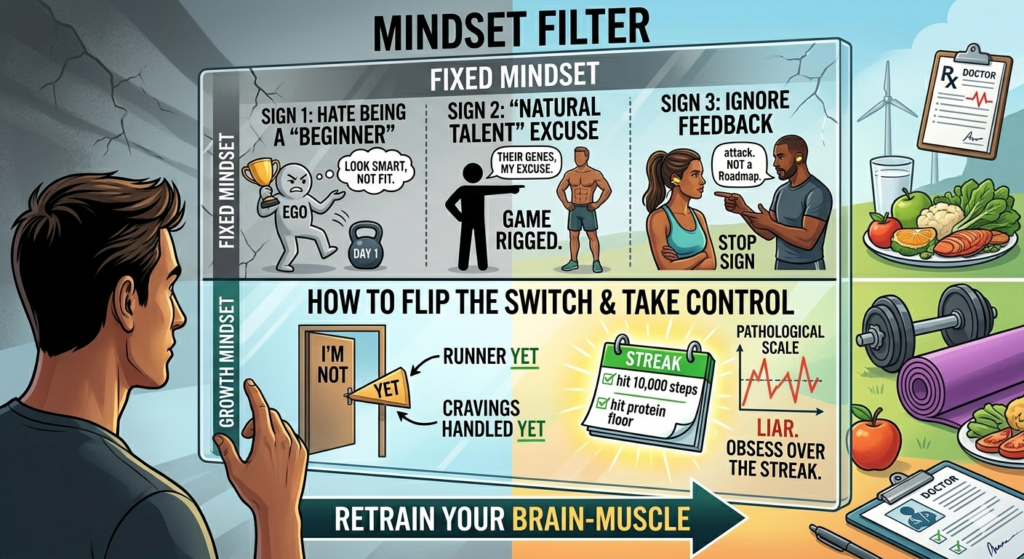
Your mindset isn’t just a set of thoughts; it’s a filter that determines which actions you take and which ones you skip. Often, this filter is working against you without you ever realizing it. Here is how a fixed mindset quietly sabotages your physical progress.
1. You Hate Being a “Beginner”
If you refuse to walk into a weight room because you’re afraid of looking weak, or you won’t join a yoga class because you aren’t flexible yet, your fixed mindset is winning. You are prioritizing your ego over your evolution.
In a fixed mindset, you believe your current ability is a reflection of your worth. You’re more worried about “looking smart” or “looking fit” than actually putting in the work to become those things. You stay in your comfort zone to avoid the embarrassment of the learning curve, but the comfort zone is where health goes to die.
2. You Think “Natural Talent” is Everything
When you see someone with incredible stamina or a lean physique and immediately think, “They just have great genes,” you’re using a defense mechanism.
Yes, genetics provide the blueprint, but effort builds the house. By labeling others as “naturally gifted,” you create a convenient excuse for yourself. It’s a way to justify not trying as hard because you’ve already decided the game is rigged. This thought process protects your feelings, but it keeps you stagnant. It ignores the thousands of boring, disciplined choices that person made while you weren’t looking.
3. You Ignore Feedback
How do you react when a doctor suggests a lifestyle change or a trainer corrects your form? If you feel a surge of defensiveness or start making excuses, that’s your fixed mindset talking.
A fixed mindset hears feedback as an attack on your character—it hears, “You’re doing it wrong,” or “You aren’t good enough.” It sees a critique as a final judgment. On the flip side, a growth mindset hears feedback as a competitive advantage. It hears, “Here is how to win.” One sees a stop sign; the other sees a roadmap. If you can’t take the feedback, you can’t make the fix.
How to Flip the Switch and Take Control
Mindsets aren’t hardwired. You aren’t “born” a certain way, and your brain isn’t a finished product. It’s more like a muscle—it adapts to the load you put on it. If you’ve spent years reinforcing a fixed mindset, that muscle is weak, but you can train it to be an absolute powerhouse.
Here is exactly how you start retooling your brain to work for your body instead of against it.
Stop Using “I’m Not”
Your brain is always listening to the labels you give it. When you say, “I’m not a runner,” or “I’m just not a healthy eater,” you are closing a door and locking it. You are telling your subconscious that there is no point in trying because it’s not part of your identity.
The fix is dead simple: Add one word: “Yet.”
- “I’m not a runner yet.”
- “I don’t have a handle on my sugar cravings yet.”
- “I haven’t hit my target weight yet.”
This tiny, three-letter shift is a massive psychological loophole. It acknowledges your current reality without turning it into a life sentence. It keeps the door cracked open just enough for your brain to start looking for ways to make that “yet” a reality.
Focus on the Process, Not the Result
The scale is a pathological liar. It fluctuates based on how much salt you ate last night, your hydration levels, your stress, and your hormones. If your entire mood for the day depends on that number, you’ve already lost. You’re letting a variable you can’t fully control dictate your self-worth.
Stop obsessing over the outcome and start obsessing over the “streak.”
Shift your focus to the “Process Goals”—the things you can 100% control.
- Did you hit your protein floor today?
- Did you get your 10,000 steps?
- Did you drink enough water?
If you check those boxes, you won the day. Period. Results are just the inevitable side effect of a long enough streak of winning days. When you fall in love with the process, the results eventually stop being a surprise and start being a guarantee.
Embrace the “Burn”
In a fixed mindset, physical discomfort is a warning sign. When your lungs start to huff or your muscles start to fire during a workout, the fixed mindset says, “This is too hard; I’m not built for this; I should stop before I look stupid.”
In a growth mindset, that burn is the sound of your body changing. It’s the “ping” of a notification telling you that you’ve finally reached the threshold where adaptation happens.
Growth doesn’t happen during the easy sets. It happens in the final two reps where your form starts to shake. It happens in the last five minutes of the walk when you really want to turn back. When things get difficult, don’t back off—lean in. Remind yourself that the discomfort is the literal feeling of your old self being replaced by a stronger version. If it doesn’t challenge you, it’s not changing you.
The Bottom Line
Your body is incredibly adaptable, but it won’t change until your mind does. Stop treating your health like a lottery you didn’t win. Start treating it like a skill you’re learning.
What’s one “fixed” belief you’re carrying about your health right now? Throw it out and replace it with a question. Instead of “I can’t lose weight,” ask “What is one thing I can change in my routine this week?”
Note: Mindset is powerful, but biology is real. Always talk to a doctor before starting a new health or fitness plan.