

Every dream you have lives on the other side of failure. This post reframes failure not as a dead end, but as the most direct route to success — and gives you a practical mindset framework to stop fearing it and start using it as fuel.Reviewed by resilience researchers • Updated May 2026

Before you read another word — answer this honestly
When was the last time you stopped yourself from trying something because you were afraid of failing?
If a moment came to mind immediately — a business idea you shelved, a conversation you avoided, a dream you quietly folded up and put away — you are not alone.
Most people carry a graveyard of unfinished beginnings. Not because they lacked talent or intelligence. But because somewhere along the way, they learned to treat failure as the enemy.
It isn’t. And this post is going to prove it to you.
The Man Who Refused to Call It Failure
A real story worth remembering
In 1952, a 62-year-old man named Harland climbed into his car with a pressure cooker and a recipe. He’d just been forced out of a roadside restaurant he’d built over 30 years. His first Social Security check — $105 — had just arrived. By most measurements, this was a man who had failed.
He drove from town to town, sleeping in the back of his car, cooking chicken for restaurant owners in exchange for a handshake deal. He was rejected over 1,000 times.
He didn’t call it failure. He called it research.
Harland Sanders — Colonel Sanders — launched Kentucky Fried Chicken at 62. By 73, he sold the company for $2 million (roughly $16 million today). He remained its global face until he died at 90.
His story doesn’t belong in a motivational poster. It belongs in your bones — because it answers the question most older adults wrestle with quietly at 2 a.m.:
“Is it too late for me to try again?”
The answer is not a platitude. The answer is evidence.
Why We Fear Failure More as We Age (And Why That Fear Is Lying to You)
The fear of failure isn’t irrational. In many ways, it’s earned. By the time most of us reach our 50s, 60s, and beyond, we’ve collected real losses — businesses, relationships, health scares, missed opportunities. We’ve felt what failure costs.
That accumulated experience creates something psychologists call loss aversion: the tendency to feel the pain of a loss far more intensely than the pleasure of an equivalent gain.

What the science actually says
Research published in the Journal of Personality and Social Psychology (Heckhausen, Wrosch & Schulz, 2010) found that older adults are more likely to disengage from goals after setbacks — not because they lack resilience, but because they’ve become more selective about where they invest emotional energy.
However, the same body of research found that adults who reframe setbacks as information rather than judgment demonstrate significantly higher life satisfaction, emotional resilience, and goal persistence. Source: PubMed / NIH-indexed research
Translation: the problem isn’t that you feel the fear. The problem is what you’ve been taught to do with it.
“Failure is not the opposite of success. It is the tuition you pay for it.”
You haven’t been failing. You’ve been paying tuition. The question is — are you still enrolled?
The Invisible Cost of Avoiding Failure
Here’s what nobody talks about clearly enough.
Avoiding failure doesn’t protect you. It creates a different kind of loss — quieter, slower, and harder to name. It is the accumulation of things never tried, never risked, never fully lived.
Margaret’s story — this one is for every person who played it safe
Margaret spent 34 years as a secondary school teacher. She loved children. She was good at her job. But her real dream — the one she’d carried since her early 30s — was to write a novel.
She told herself she’d do it after the children grew up. Then after retirement. Then after her knee surgery. Then after her husband recovered from his heart procedure.
She never failed at writing the novel. She never started it. And at 74, sitting with her granddaughter who asked “Grandma, what did you always want to do?” — she cried.
Not because the novel would have been a bestseller. But because she had protected herself from failing so carefully — that she had also protected herself from trying.
Margaret’s story is not rare. It is, in fact, the most common story of all.
The research term for this is inaction regret, and according to studies from Cornell University, it becomes the dominant form of regret as we age. We regret the things we didn’t do far more than the things we tried and failed at.
Stay with this — it matters
You are not afraid of failure. You are afraid of how failure will make you feel. That is an entirely different problem — and it has an entirely different solution.
Reframing Failure: What It Actually Is vs. What We Were Taught
Most of us were taught — in school, at home, through culture — that failure is the opposite of success. A verdict. A destination. A closed door with a sign that reads “not good enough.”
That framing is wrong. And more importantly, it’s been measurably proven wrong.
Failure as Feedback, Not Judgment
Every failure contains data. Not a verdict on who you are — but information about what didn’t work, what you need to learn, what adjustment to make next time.
Thomas Edison didn’t fail to invent the lightbulb 10,000 times. He found 10,000 ways that didn’t work — each one narrowing the field, each one bringing him closer. The method was the path.
Failure as Proof of Courage
Here is the part most people miss entirely: you cannot fail at something you never tried. Which means every failure in your life is, at its root, evidence of bravery.
You tried. That matters. That counts. That is not nothing.
Failure as Redirection
A quiet redirection that changed everything
James had built a small construction business over 20 years. At 58, the business collapsed — a combination of rising costs, a difficult contract, and a partner who walked away. He lost nearly everything.
In the wreckage, he started helping a neighbor — a widow in her 70s — with small repairs around her home. She told her friends. They told their friends.
Within two years, James was running a one-man home maintenance service specifically for elderly residents in his town. He earned less money. He worked better hours. He felt more useful than he had in decades.
“The business failing,” he said, “was the best thing that ever happened to me. I just didn’t know it for eighteen months.”
The 5-Step Failure Reframe Framework
This isn’t theory. This is a practical set of questions and actions you can use the next time you fail — or the next time you’re afraid to start.
The Failure Reframe Framework — five steps that actually work
1
Name it without judgment
Say clearly what happened, without loaded language. Not “I failed” — but “This specific thing did not go as I intended.” Precision reduces shame.
2
Extract the data
Ask: What did I learn? What worked, even slightly? What would I do differently? Failure is a lab report, not a report card.
3
Separate the event from your identity
You are not your failure. A business that closes is not a person who is broken. A relationship that ends is not proof that you are unlovable. Keep them separate — rigorously.
4
Give yourself time, not infinity
Grief after failure is natural and healthy. Set a soft internal boundary — “I will let myself feel this fully for two weeks” — and then begin looking forward. Not forcing positivity. Just choosing a direction.
5
Take one small next action
Not a grand comeback. Not a new plan. One small, concrete action that moves you forward by an inch. Momentum is rebuilt in centimeters, not miles.
What the Research Tells Us About Resilience After Failure
The science of resilience has grown enormously over the past two decades, and the findings consistently challenge the idea that resilience is a trait you’re either born with or not.
Research-backed resilience insights
A landmark study published in the American Psychologist journal (Bonanno, 2004) found that most adults who experience significant setbacks — including loss, failure, and trauma — return to healthy baseline functioning within one to two years, without professional intervention.
More importantly, a subset of these adults showed what researchers called “post-failure growth” — they emerged with stronger self-awareness, deeper relationships, and greater clarity of purpose than before the setback. Source: PubMed (PMID: 15631563)
Resilience, the research shows, is less about bouncing back — and more about bouncing forward. Not to where you were, but to somewhere new that you couldn’t have reached without the fall.
“Post-failure growth is not a gift. It is a skill. And every skill can be learned — at any age.”
It Is Never Too Late — The Evidence
For older readers especially, the most stubborn fear isn’t just of failure itself. It’s the fear that even if you try again, the clock has already run out on you.
Let the record speak.
Vera Wang didn’t design her first dress until she was 40, after failing to make the US Olympic Figure Skating team and being passed over for Editor-in-Chief at Vogue. She is now considered one of the greatest bridal designers in history.
Grandma Moses — Anna Mary Robertson Moses — began painting seriously at 78, after arthritis made embroidery too difficult. She produced over 1,500 paintings. Her work now hangs in major museums worldwide.
Charles Darwin published On the Origin of Species at 50, after spending decades doubting whether his ideas were good enough to share.
These are not people who succeeded despite their failures and late starts. They succeeded through them.
The question that changes everything
What would you attempt right now if you were absolutely guaranteed that failing would not define you — only teach you?
People Also Ask: Your Questions, Answered Honestly
How do I stop being afraid of failure at my age?
Start by distinguishing between the fear of failure and the fear of judgment. Most adults fear what others will think more than the failure itself. Reducing your exposure to unsolicited opinions while increasing small, low-stakes attempts is the most effective — and evidence-supported — path to rebuilding confidence.
Is it normal to feel more afraid of failure as you get older?
Yes, and it’s understandable. With more life experience comes a deeper awareness of what loss feels like. But research consistently shows that older adults who continue to take purposeful risks report higher satisfaction and wellbeing than those who play it safe. The fear is normal. Letting it make all your decisions is not inevitable.
What is the psychology behind the fear of failure?
Psychologists call it atychiphobia in its extreme form, but most people experience a milder version rooted in self-worth contingency — the belief that your value as a person depends on your outcomes. Cognitive Behavioral Therapy (CBT) and mindfulness-based approaches have strong evidence for reducing this pattern. Speaking with a qualified therapist is always a worthwhile first step.
Can failure actually make you stronger? Is that scientifically true?
Yes. The concept of post-traumatic growth (PTG), studied extensively by psychologists Richard Tedeschi and Lawrence Calhoun at UNC Charlotte, documents consistent patterns of personal growth — including increased resilience, deeper relationships, and a stronger sense of purpose — following significant setbacks. The growth isn’t automatic, but it is accessible to most people with the right support and framing.
The Conclusion: A Direct Conversation Before You Go
You made it to the end of this. That tells me something about you.
You haven’t given up. Not entirely. Some part of you is still listening, still wondering, still reaching. That part — however quiet it has grown — is the most important part of you.

Here is what I want to leave you with:
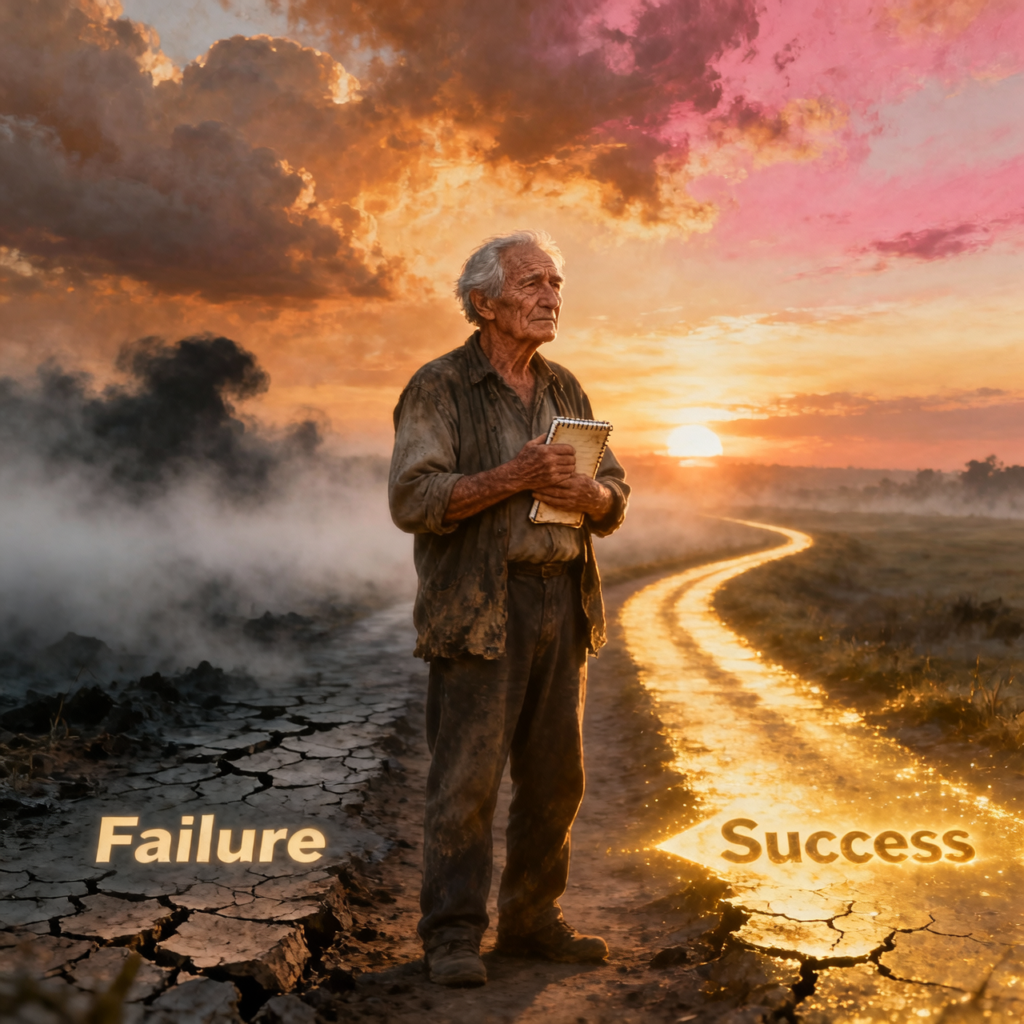
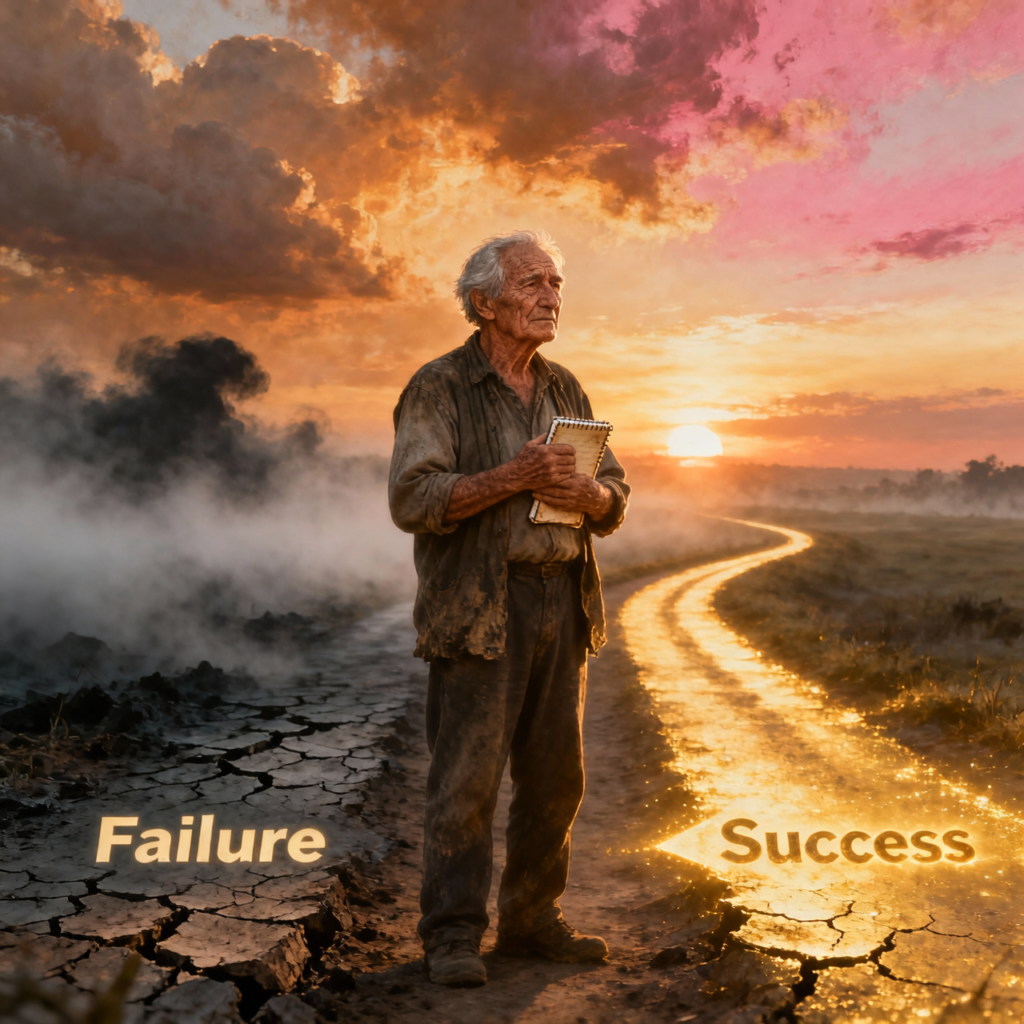
Failure is not a full stop at the end of your story. It is a comma. It is the breath between one chapter and the next. It is, if you let it be, the very thing that gives the next chapter its meaning.
You do not have to be fearless. You just have to be willing to take the next step while the fear is still there — because that is the only kind of courage that has ever existed.
The path forward isn’t around failure. It runs right through it.
Your One Action Step for Today
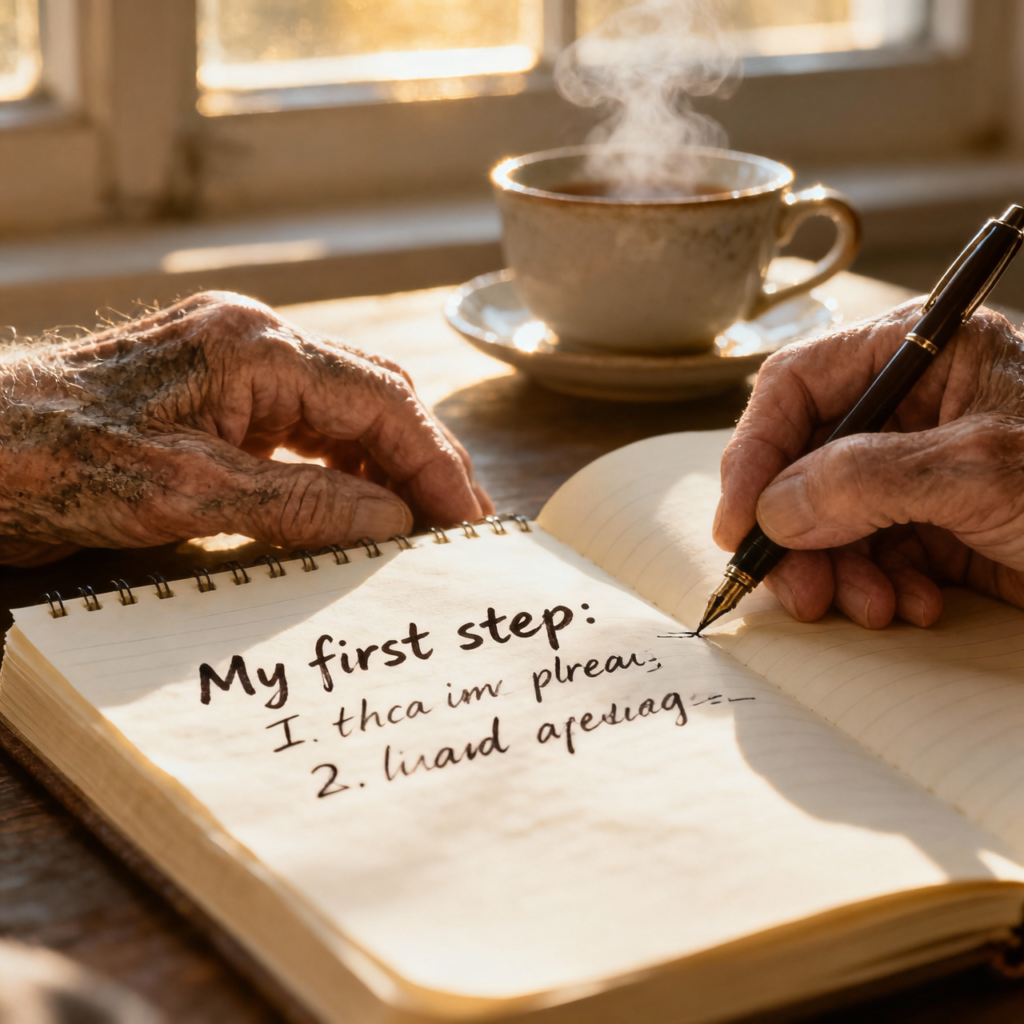
Write down one thing you’ve been avoiding because you’re afraid of failing. Then ask yourself: what is the smallest possible first step I could take this week? Not the whole plan. Just the first step.
Share Your First Step →
A note on professional support: This post addresses mindset and resilience from an educational perspective and is not a substitute for professional mental health support. If fear of failure is significantly impacting your daily life, relationships, or wellbeing, please consider speaking with a licensed therapist or counselor. There is no shame in seeking help — in fact, doing so is its own form of courage.
This post is intended for general educational purposes. Research citations reference peer-reviewed sources indexed by PubMed and the NIH. Individual experiences vary. If you are experiencing persistent anxiety, please consult a qualified healthcare professional.