
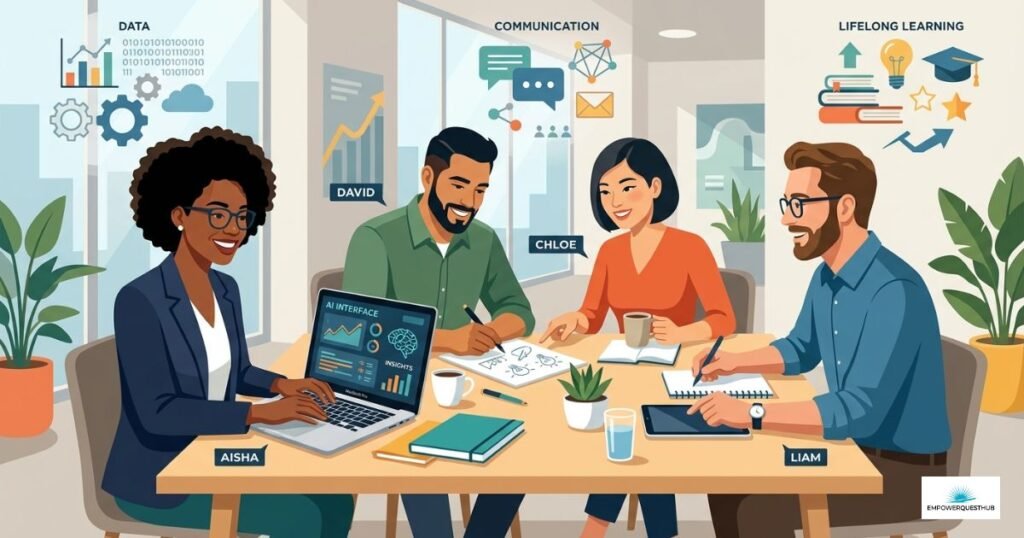
Discover the future-proof skills employers are hiring for in 2026 — AI literacy, data analysis, communication — and how to build and prove them.
Work is changing faster than most job descriptions can keep up with. AI tools are showing up inside everyday workflows, hiring teams are rewriting what “qualified” means, and the career ladder a lot of people grew up expecting — one degree, one industry, one steady climb — looks a lot less linear than it used to.
Being “future-proof” doesn’t mean finding the one skill that can never become obsolete. No such skill exists. What it actually means is building a combination of technical ability, AI fluency, business awareness, and human judgment that lets you adapt as tools, roles, and entire industries shift underneath you.
There’s real evidence behind this shift. LinkedIn’s 2026 Skills on the Rise research, which tracks year-over-year growth in skills people add to their profiles and the hiring activity behind them, points to companies increasingly prioritizing demonstrated capability over titles and traditional resumes. Recruiters are searching by skill, not just by job history, and AI-related capability now shows up across nearly every function LinkedIn tracks — not just engineering. This guide breaks down which skills are actually rising, why employers care about them, and how you can realistically start building them, whatever stage of your career you’re at.
What Does “Future-Proof Skills” Mean?
A future-proof skill isn’t a magic credential — it’s a capability that stays useful even as the tools and job titles around it change. It helps to separate three different things people often lump together:
- A tool-specific skill — knowing how to use one particular piece of software. Useful, but it can lose value fast if the tool gets replaced.
- A transferable skill — something like data analysis or project coordination that carries over between industries and roles, even if the specific tools change.
- A durable capability — a deeper trait like critical thinking, adaptability, or communication that underlies almost everything you do at work, regardless of what technology arrives next.
Future-proofing a career isn’t about betting on one skill. It’s the combination of adaptability, continuous learning, and practical application — using what you know on real problems, not just collecting certificates.
Why Companies Are Hiring for Skills Instead of Just Degrees
Skills-based hiring has been building momentum for years, and 2026 data shows it accelerating. LinkedIn reports that a large share of recruiters on its platform now explicitly use skills data — not just job titles or degrees — to fill open roles. Employers increasingly want to see:
- Practical, demonstrated ability
- Portfolios and real work samples
- Completed projects, not just listed responsibilities
- Relevant certifications
- Evidence of problem-solving under real constraints
- A track record of adapting to new tools or situations
This doesn’t mean degrees have become irrelevant — that depends heavily on the field. Regulated professions like law, medicine, and engineering still require formal credentials, and some corporate roles still filter by degree. But across a growing number of functions — marketing, sales, design, content, operations, tech — employers are weighting demonstrated skill more heavily than they used to, especially for mid-career hires and career changers.
The Most Future-Proof Skills Companies Are Hiring for in 2026

AI literacy is bigger than knowing how to write a good prompt. It’s the ability to understand what AI tools can and can’t reliably do, use them responsibly, evaluate their output critically, and fold them into your actual workflow.
LinkedIn’s research has repeatedly flagged AI-related capability as one of the fastest-growing skill categories, and its 2026 data shows AI fluency spreading well beyond engineering teams into marketing, operations, HR, and leadership roles.
Almost every function today — marketers using AI for research and drafts, analysts using it to summarize data, support teams using it to triage tickets, executives using it for strategic scenario planning.
Start using AI tools for real tasks in your current job—drafting, summarizing, brainstorming — and pay close attention to where the output is wrong or shallow. That’s where you build judgment, not just familiarity.
How to show it: Describe specific outcomes: “Used AI-assisted research to cut report preparation time,” not just “familiar with AI tools.”
2. Data Analysis and Data Literacy

You don’t need to become a data scientist to benefit from data literacy. Basic comfort with spreadsheets, dashboards, and interpreting numbers is increasingly expected across roles that have nothing to do with a “data” job title.
Decisions increasingly get backed by data, and employees who can read a dashboard and draw a reasonable conclusion save managers time and reduce guesswork.
Marketers reading campaign performance, HR analyzing retention trends, sales reps tracking pipeline health, operations teams monitoring efficiency.
Get comfortable with spreadsheet formulas, pivot tables, and simple visualization tools. Practice on your own team’s real numbers if you can.
Include a specific example—a dashboard you built, a trend you identified, a decision your analysis influenced.
3. Critical Thinking

As AI-generated content and information floods every channel, the ability to evaluate what’s actually accurate and relevant becomes more valuable, not less.
Why employers value it: Employees who accept information — human or AI-generated — at face value make more mistakes. Critical thinkers catch errors before they become expensive.
Who uses it: Every role that involves decisions, from customer service escalations to executive strategy.
How to build it: Practice deliberately questioning assumptions in your own work — ask “what’s the evidence for this?” before accepting a conclusion, including your own.
How to show it: Walk through a time you caught a flawed assumption or corrected a mistake before it caused a problem.
4. Strategic Thinking
Strategic thinking is the ability to connect your day-to-day work to bigger business priorities — understanding not just what to do, but why it matters and what trade-offs it involves.
Why employers value it: LinkedIn’s skills research has consistently placed strategic thinking among the fastest-growing skills across multiple markets, reflecting employer demand for people who can think beyond their immediate task list.
Who uses it: Anyone moving toward leadership, but also individual contributors who want more autonomy and trust.
How to build it: Regularly ask how your work connects to your team’s goals and your company’s broader objectives — then start proposing improvements, not just executing tasks.
How to show it: Share an example where you identified a risk or opportunity that wasn’t part of your assigned task.
5. Adaptability and Resilience
Tools, processes, and even entire job descriptions are shifting faster than they used to. The ability to adjust without losing momentum has become a genuine competitive advantage.
Why employers value it: Teams that constantly retrain new hires on “the old way” lose time. Employees who pick up new systems and workflows quickly reduce that friction.
Who uses it: Virtually every role, especially in companies actively adopting new technology.
How to build it: Volunteer for projects involving new tools or unfamiliar processes rather than avoiding them.
How to show it: Describe a time you had to learn a new system or adjust to a major change quickly, and what you did to stay effective.
6. Communication
Written and verbal communication remain some of the most consistently in-demand skills, and AI hasn’t reduced that need — if anything, it’s made clear, human communication more valuable as a differentiator.
Why employers value it: Miscommunication costs time, money, and trust. Clear communicators reduce friction across teams, especially in remote and hybrid environments.
What it includes: Written clarity, verbal presentation, active listening, and knowing how to communicate effectively across async channels like email, Slack, or project tools.
How to build it: Practice writing shorter, clearer messages. Ask for feedback on presentations. Record yourself explaining a concept and review it critically.
How to show it: Point to specific outcomes — a proposal that got approved because of how it was framed, a presentation that led to a decision.
7. Creative and Innovative Thinking
Creativity isn’t limited to design and content roles. It shows up in how people solve problems, improve processes, and generate new ideas under real constraints.
Why employers value it: Businesses need people who can generate new approaches, not just execute existing playbooks — especially as competition and automation compress margins for “business as usual.”
Who uses it: Product teams, marketers, designers, but also operations and customer service teams improving processes.
How to build it: Practice brainstorming multiple solutions to a problem before picking one, even for small tasks.
How to show it: Share a specific idea you generated that was implemented and had a measurable effect.
8. Problem-Solving
Employers consistently look for people who can work through problems methodically rather than reactively. A simple, repeatable framework helps:
Identify → Analyze → Generate Solutions → Test → Measure → Improve
Why employers value it: This skill applies to nearly every function — a support team resolving a recurring complaint, an engineer debugging a system, a marketer fixing an underperforming campaign.
How to build it: Apply this framework consciously to a real problem at work, even a small one, and document what you tried and what worked.
How to show it: Frame resume bullets around the problem you solved and the measurable result, not just the task you completed.
9. Automation and Workflow Optimization
Automating repetitive work — using no-code tools, AI, or simple integrations — frees up time for higher-value work, and employers increasingly expect employees to spot these opportunities themselves.
Why employers value it: Teams that automate reporting, data entry, or routine communication move faster and make fewer errors.
Who uses it: Marketing (automated reporting), operations (workflow tools), sales (CRM automation), finance (automated reconciliation).
How to build it: Learn one no-code automation tool and use it to remove a repetitive task from your own workload.
How to show it: Quantify the time saved: “Automated weekly reporting, reducing manual work by several hours per week.”
10. Cybersecurity Awareness
You don’t need to be in IT to need basic cybersecurity knowledge anymore. As phishing and social engineering attacks get more sophisticated, awareness has become a baseline workplace expectation.
Why employers value it: A single employee falling for a phishing email can compromise an entire company’s data. Basic awareness reduces that risk significantly.
What it includes: Recognizing phishing attempts, using strong and unique passwords, understanding data privacy basics, and knowing how to share files securely.
How to build it: Complete a basic cybersecurity awareness course — many are free — and apply the habits immediately.
How to show it: Mention any security-related training or practices you’ve implemented, even informally, in past roles.
11. Leadership and Social Influence
Leadership isn’t reserved for people with “manager” in their title. Employers increasingly value people who take ownership, influence outcomes, and support their teams regardless of formal authority.
Why employers value it: Organizations run more smoothly when people at every level take initiative instead of waiting to be told what to do.
What it includes: Taking ownership of outcomes, influencing stakeholders without formal authority, coordinating across teams, mentoring others, and being accountable when things go wrong.
How to build it: Volunteer to lead a small project or mentor a newer colleague, even informally.
How to show it: Describe a specific instance where you influenced a decision or outcome without being asked to.
12. Emotional Intelligence
Emotional intelligence — self-awareness, empathy, and the ability to manage conflict constructively — directly affects how well people collaborate, especially under pressure.
Why employers value it: Teams with strong emotional intelligence experience less unresolved conflict and better collaboration, particularly across remote and cross-cultural teams.
What it includes: Recognizing your own emotional reactions, understanding others’ perspectives, managing disagreements productively, and building durable working relationships.
How to build it: Practice pausing before reacting in tense situations, and actively ask colleagues for their perspective before assuming you understand it.
How to show it: Share an example of resolving a conflict or supporting a colleague through a difficult project.
13. Domain Expertise + Technology
Some of the strongest career positioning in 2026 comes from combining deep knowledge of an industry with modern technology skills — rather than treating them as separate paths.
Examples of this pairing:
- Healthcare + AI (clinical knowledge combined with AI-assisted diagnostics or documentation tools)
- Marketing + analytics (campaign strategy combined with performance data)
- Finance + automation (financial expertise combined with automated reporting tools)
- Content + AI (writing skill combined with AI-assisted research and production)
- Sales + CRM/data (relationship skills combined with pipeline and behavioral data)
- Design + generative AI (design judgment combined with AI-assisted iteration)
Why it matters: Generalist AI skills are becoming common. Deep industry knowledge paired with technical fluency is harder to replicate and tends to be more defensible over time.
14. Lifelong Learning
The half-life of specific technical skills keeps shrinking. The habit of continuously learning — not any single credential — is what keeps people employable over a full career.
Why employers value it: Employees who keep learning need less retraining and adapt faster to new tools and processes.
How to build it: Use microlearning (short courses, tutorials), take on stretch projects, join relevant communities, and find a mentor if possible. Learning by doing tends to stick better than passive coursework alone.
How to show it: List recent courses or certifications alongside a concrete project where you applied what you learned — the application matters more than the certificate itself.
15. Digital Collaboration
Remote and hybrid work have made digital collaboration skills — not just technical fluency, but habits around documentation, async communication, and project coordination — a baseline expectation.
What it includes: Comfort with project management tools, clear written documentation, effective async communication, and staying organized across digital workspaces.
Why employers value it: Distributed teams depend on people who can collaborate effectively without constant real-time meetings.
How to build it: Get proficient with common collaboration tools (project trackers, shared docs, async messaging platforms) and practice documenting your work clearly enough that someone else could pick it up.
The Most Powerful Skill Combinations for 2026

Individual skills matter, but employers increasingly value combinations — because hybrid skill sets are harder to automate and harder to find.
| Skill Combination | Potential Career Advantage |
| AI + Marketing | AI-powered marketing strategy and execution |
| AI + Content | AI-assisted content strategy and production |
| Data + Business | Data-driven decision making |
| Cybersecurity + IT | Security-focused technology roles |
| Communication + Leadership | Management and stakeholder-facing roles |
| Creativity + AI | AI-enhanced creative and design work |
| Domain Expertise + AI | Industry-specific AI application roles |
A single skill can be learned by almost anyone with enough time. A well-chosen combination is much harder to replicate — and it’s usually what actually gets someone hired over an equally qualified competitor.
Technical Skills vs Soft Skills — Which Matter More?
This isn’t really an either/or question, and treating it that way leads to bad career decisions. The strongest candidates typically combine:
Technical ability + AI literacy + human judgment + communication
A data analyst who can build a dashboard but can’t explain what it means to a non-technical stakeholder is only half as valuable as one who can do both. A manager with strong people skills but no comfort with the tools their team uses will struggle to lead effectively. Employers aren’t choosing between technical and soft skills — they’re increasingly looking for people who have a credible level of both.
How to Build Future-Proof Skills Without Going Back to College
You don’t need another degree to build most of these skills. A practical, self-directed roadmap looks like this:
Step 1: Choose one career direction. Trying to prepare for every possible path at once leads to shallow progress everywhere.
Step 2: Identify 3–5 high-value skills relevant to that direction, based on job postings and industry research.
Step 3: Learn the fundamentals through structured courses, tutorials, or documentation.
Step 4: Build practical projects that apply what you’re learning to something real, even a small personal project.
Step 5: Create a portfolio that documents your projects, decisions, and outcomes.
Step 6: Add relevant certifications where they genuinely add credibility — not just for the sake of collecting them.
Step 7: Apply the skills to real problems, ideally in your current job or through freelance work.
Step 8: Document measurable results wherever possible — time saved, revenue influenced, errors reduced.
Step 9: Update your LinkedIn and resume to reflect the skills and results, not just the tasks.
Step 10: Continue learning. This isn’t a one-time project — it’s an ongoing habit.
How to Prove Your Skills to Employers
Simply listing “AI,” “leadership,” or “communication” on a resume doesn’t do much — everyone lists those. What actually convinces employers is evidence.
Ways to demonstrate skills convincingly:
- Portfolio projects with real outcomes
- Case studies walking through a specific problem and solution
- Freelance work or internships
- Relevant certifications paired with applied projects
- Public work samples (writing, code, designs) where relevant
- Before-and-after results
- Business outcomes tied to your work
Responsible for social media marketing.”
“Rebuilt the content calendar using AI-assisted research, cutting planning time by a third while increasing posting consistency.”
The difference is specificity and outcome — not just describing a responsibility, but showing what changed because of your work.
How AI Is Changing the Skills Employers Want
It’s tempting to treat “AI skills” as their own separate career track, but a more accurate way to think about it is that AI has become a capability layer across almost every job — similar to how digital literacy or basic computer skills became a baseline expectation over the past two decades.
Increasingly, employees are expected to:
- Work alongside AI tools in their daily workflow
- Check and validate AI-generated output rather than accepting it uncritically
- Understand where AI tools are reliable and where they aren’t
- Protect sensitive information when using AI systems
- Integrate AI into existing processes rather than treating it as a separate task
- Apply human judgment to decisions AI can’t fully make on its own
It’s worth being clear-eyed here: the sweeping predictions of mass, near-term job elimination haven’t matched what’s actually shown up in labor-market data so far. Recent economic analysis has found that employment among workers most exposed to AI has remained largely stable, even as AI adoption has accelerated. Economists broadly describe the current effect as changing the composition of jobs — some tasks automated, some roles reshaped, some new roles created — rather than a simple story of mass elimination. That said, entry-level hiring in some fields has tightened, and forecasts from organizations like the World Economic Forum suggest significant job displacement and creation are both likely by 2030, alongside a persistent gap between the skills employers need and the skills the current workforce has. The safest career strategy isn’t betting on a single prediction — it’s building the adaptability to respond to whichever version of the future actually arrives.
A 90-Day Future-Proof Skills Plan
Days 1–30: Learn fundamentals. Pick your 3–5 target skills and work through foundational courses or tutorials. Aim for consistent, shorter sessions (3–5 hours per week) rather than occasional long ones.
Days 31–60: Build practical projects. Apply what you’ve learned to at least one real project — something you could show a hiring manager or client, even if it’s small.
Days 61–90: Create a portfolio, optimize your LinkedIn/resume, and start applying. Document your projects and results, update your profiles to reflect them, and begin using these skills in real opportunities — whether that’s a new job application, a freelance project, or a bigger role within your current company.
A simple weekly rhythm that works for most people: 2–3 short learning sessions, 1 applied practice session, and periodic review of what’s actually sticking versus what needs revisiting.
Common Mistakes to Avoid
- Learning too many skills at once. Depth beats breadth — a few well-developed skills outperform a long list of shallow ones.
- Chasing every new AI tool. Tools change constantly; the underlying judgment about how to use them well is what actually transfers.
- Collecting certificates without practical experience. A certificate with no applied project behind it rarely convinces employers on its own.
- Ignoring communication skills in favor of purely technical development.
- Failing to build a portfolio to demonstrate the skills you’ve developed.
- Not measuring results, so you can’t show the actual impact of your work.
- Learning without a career target, which leads to scattered, unfocused effort.
- Assuming one skill will remain valuable forever. Even in-demand skills today will evolve — the habit of learning matters more than any single skill.
How to Choose the Right Future-Proof Skills for Your Career
A simple framework can help you focus your effort:
Current Role → Industry Demand → Skill Gap → Learning Path → Practical Project → Proof of Skill
Some examples of how this plays out:
- Content writer: Current role in written content → industry demand for AI-assisted content workflows → gap in AI literacy and data-informed content strategy → learning path in AI writing tools and basic analytics → project: an AI-assisted content series with measurable engagement results → proof: portfolio piece with before/after performance data.
- Digital marketer: Current role in campaign management → industry demand for AI-powered marketing and automation → gap in data analysis and automation tools → learning path in analytics platforms and no-code automation → project: an automated reporting workflow → proof: documented time savings and campaign performance improvement.
- Graphic designer: Current role in visual design → industry demand for AI-assisted design workflows → gap in generative AI tools → learning path in AI-assisted design software → project: a redesigned asset library using AI-assisted iteration → proof: a before/after portfolio comparison.
- Business analyst: Current role in reporting → industry demand for AI-informed decision support → gap in AI literacy and advanced data visualization → learning path in AI tools for analysis and dashboarding platforms → project: an AI-assisted forecasting dashboard → proof: a case study showing improved decision speed or accuracy.
- Software developer: Current role in coding → industry demand for AI-assisted development and code review → gap in AI coding tools and prompt-based workflows → learning path in AI pair-programming tools → project: a feature built with AI-assisted development → proof: measurable reduction in development time.
- Sales professional: Current role in client relationships → industry demand for data-informed, CRM-integrated sales → gap in CRM analytics and AI-assisted outreach → learning path in CRM tools and sales automation → project: an AI-assisted outreach sequence → proof: documented conversion improvement.
FAQ
1. What are the most future-proof skills for 2026?
AI literacy, data analysis, critical thinking, adaptability, communication, and domain expertise combined with technology consistently rank among the most in-demand capabilities, according to recent LinkedIn and World Economic Forum research.
2. What skills are companies hiring for in 2026?
Employers are prioritizing a mix of AI-related capability, operational efficiency, data literacy, communication, and leadership skills — with hiring increasingly based on demonstrated ability rather than degrees or job titles alone.
3. Is AI literacy a valuable career skill?
Yes. AI literacy has been one of the fastest-growing skill categories in recent LinkedIn research and is spreading across nearly every job function, not just technical roles.
4. What skills will be in demand in the future?
Beyond specific tools, durable capabilities like adaptability, critical thinking, and communication are expected to remain valuable because they support learning new tools and processes as they emerge.
5. Are soft skills still important in 2026?
Yes. Soft skills like communication, leadership, and emotional intelligence made up roughly half of LinkedIn’s recent skills-on-the-rise lists, showing they remain just as valued as technical skills.
6. How can I future-proof my career?
Focus on building a combination of technical, AI, and human skills relevant to your field, apply them to real projects, document measurable outcomes, and keep learning continuously rather than treating any single skill as a permanent solution.
7. Which skills should I learn for remote jobs?
Digital collaboration, written communication, self-management, and comfort with project management and async communication tools are especially important for remote and hybrid roles.
8. Can AI skills help me get hired?
Yes, particularly when paired with domain expertise. Employers increasingly expect baseline AI fluency across functions, and demonstrating how you’ve applied AI tools to real outcomes can meaningfully strengthen a resume or portfolio.
9. Are certifications enough to get a job?
Rarely on their own. Certifications carry more weight when paired with a practical project or real-world application that shows you can actually use the skill, not just that you completed a course.
10. What is the best skill to learn in 2026?
There isn’t one single best skill — the strongest career positioning comes from combining a technical or AI-related skill with a durable human capability like communication, critical thinking, or domain expertise.
Featured Snippet Targets
What are future-proof skills?
Future-proof skills are capabilities — technical, AI-related, and human — that remain valuable as tools, roles, and industries change. Rather than one permanent skill, future-proofing relies on combining adaptability, continuous learning, and practical application across evolving workplace demands.
What skills are companies looking for in 2026?
Companies are hiring for AI literacy, data analysis, critical thinking, communication, adaptability, and leadership, often prioritizing demonstrated skills and practical experience over degrees, according to LinkedIn’s 2026 skills research.
How can I future-proof my career?
Build a combination of technical, AI, and human skills relevant to your field, apply them through real projects, document measurable results, and continue learning as tools and job requirements evolve over time.
Is AI literacy an important skill in 2026?
Yes. AI literacy is among the fastest-growing skills tracked by LinkedIn’s recent research and is increasingly expected across marketing, operations, leadership, and other non-technical roles, not just engineering.