
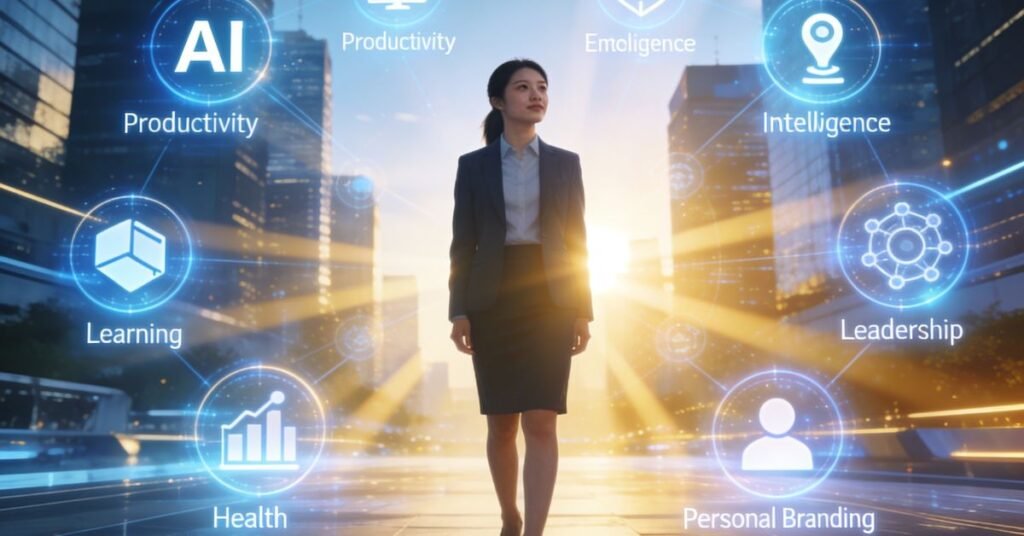
Discover the top personal development trends for 2026—from AI-driven growth to emotional intelligence and lifelong learning—with a practical 90-day action plan.
Something has quietly shifted in how people think about growing themselves. For most of the last decade, personal development meant optimization: more habits, more metrics, more hustle. In 2026, a different question is surfacing across coaching circles, HR departments, and everyday conversations — not “how do I do more,” but “how do I grow in a way that actually holds up under pressure?”
That question matters because the context around growth has changed. Work is being reshaped by AI faster than most training programs can keep up with. The World Economic Forum’s Future of Jobs Report 2026 estimates that automation and AI will displace roughly 92 million jobs globally by 2030 while creating around 170 million new ones — a net gain, but one that requires most of today’s workforce to reskill substantially to qualify for it. At the same time, the global personal development market itself is projected to keep growing at a compound annual rate of roughly 5.5–5.8% through the early 2030s, driven largely by digital coaching platforms, AI-personalized learning, and a growing recognition that mental wellness and skill-building are no longer separate tracks.
This guide breaks down the ten personal development trends actually shaping 2026 — grounded in labor-market data, workplace research, and the practical shifts coaches and psychologists are observing in real client work. You’ll get a clear explanation of each trend, how to act on it without overhauling your life, the mistakes that undercut most self-improvement efforts, and a 90-day plan to put it all into practice.
Why Personal Development Matters More in 2026

Three forces are converging to make 2026 a genuine inflection point rather than just another year of self-help trend cycles.
First, the skills underneath most jobs are changing faster than job titles are. Analysts estimate that a substantial share of core workplace skills will shift meaningfully by 2030, driven by AI adoption, automation, and evolving business models. That means the specific tools you learned five years ago matter less than your capacity to keep learning new ones — what researchers increasingly call “meta-skills,” or the skill of acquiring skills.
Second, mental wellness has stopped being treated as separate from professional growth. Organizations that once siloed “wellness programs” from “training and development” are increasingly merging the two, on the logic that a person who is chronically stressed, under-slept, or emotionally depleted cannot sustainably build new capabilities, no matter how good the curriculum is.
Third, there’s a growing correction against growth-as-exhaustion. Clinicians and coaches are increasingly naming a pattern in high-achieving, growth-oriented people: constant self-monitoring, tracker fatigue, and a sense of pressure that doesn’t translate into fulfillment. The trend line in 2026 isn’t away from ambition — it’s away from growth strategies that produce more anxiety than progress.
Put together, these forces mean personal development in 2026 is less about adding more self-improvement content to your life and more about building a smaller number of durable capacities — adaptability, emotional regulation, digital fluency, and genuine self-awareness — that hold up regardless of what changes next.
The Top 10 Personal Development Trends for 2026

1. AI-Augmented Personal Growth
AI has moved from novelty to infrastructure in the personal development space. Coaching platforms increasingly offer AI-driven development plans that map your strengths, flag skill gaps, and recommend personalized learning resources automatically — something that used to require an expensive human coach and months of assessment.
This isn’t about outsourcing your growth to a chatbot. The most effective use of AI for personal growth right now looks like: using an AI tool to identify patterns in your own behavior, drafting a learning plan and then adjusting it against your own judgment, or using AI as a low-stakes practice partner for a difficult conversation before you have it for real. The organizations and individuals getting the most value are treating AI as a mirror and accelerant, not an authority.
2. The Future Skills Shift (Beyond Technical Skills)
Every major labor-market report converges on the same finding: technical AI literacy matters, but it’s paired — not replaced — by durable human skills like analytical thinking, creative problem-solving, and leadership. The World Economic Forum’s skills framework groups future-ready capabilities into five domains: technology skills, cognitive skills, self-efficacy, management skills, and working-with-others skills.
The practical implication is that “future skills” isn’t code for “become a programmer.” It means pairing basic fluency in AI tools with the harder-to-automate skills — judgment, communication, and creative synthesis — that become more valuable, not less, as routine tasks get automated.
3. Digital Literacy as a Baseline, Not a Bonus

Where digital skills were once a differentiator on a résumé, they’re becoming table stakes across nearly every field, including ones that historically had little to do with technology — healthcare administration, retail management, skilled trades. The specific tools matter less than the underlying comfort with learning new software quickly, evaluating AI-generated output critically, and adapting workflows as platforms change.
This trend rewards people who treat “learning a new tool” as a five-minute-a-day habit rather than a dreaded overhaul, since the tools themselves will keep changing regardless.
4. Emotional Intelligence as a Competitive Advantage
As AI absorbs more routine cognitive work, the human skills that AI is bad at — reading a room, de-escalating conflict, building trust, sensing what someone isn’t saying — are becoming disproportionately valuable. Emotional intelligence (EQ) is increasingly showing up not as a “soft skill” afterthought in job descriptions, but as a named, assessed competency in hiring and promotion decisions, especially for leadership tracks.
Developing EQ in 2026 looks less like reading a personality framework once and more like ongoing practice: naming your own emotional state before reacting, actively soliciting feedback on how you come across, and treating conflict as data rather than a threat.
5. Mental Wellness as a Foundation, Not an Add-On

The line between “wellness program” and “development program” is dissolving. A growing number of employers now treat stress management, sleep, and emotional regulation as prerequisites for skill-building rather than a separate HR initiative — the logic being that a depleted nervous system can’t absorb new learning effectively regardless of how good the training content is.
For individuals, this trend translates into a simple but important reordering: rather than treating rest and mental health as the reward for productivity, 2026’s most effective growth approaches treat them as the precondition for it.
6. The Rise of Reflective, “Calm” Growth
Perhaps the most interesting countertrend of 2026 is a pushback against optimization culture itself. Clinicians are increasingly describing a pattern among high-performing, growth-obsessed individuals — constant self-tracking, metric anxiety, and a nagging sense that doing everything “right” isn’t producing fulfillment. In response, practices that were once dismissed as old-fashioned — handwritten journaling, values-based goal setting, and deliberate unstructured pauses — are resurfacing, not as nostalgia, but because research increasingly supports their cognitive and emotional benefits.
This doesn’t mean abandoning goals or ambition. It means pairing forward motion with genuine reflection, so growth is measured by whether your life actually feels more aligned, not just whether your streak count went up.
7. Microcredentials and Skills-Based Career Mobility
Traditional degrees are being supplemented — and in some hiring contexts, partly replaced — by microcredentials: short, verifiable, skill-specific certifications that signal competency without requiring a multi-year commitment. This shift particularly benefits career-changers, freelancers, and people without access to traditional four-year education, since it creates faster, cheaper on-ramps into new fields.
The trend also reflects a broader shift toward skills-based hiring, where what you can demonstrably do increasingly matters more than the credential path you took to get there.
8. Personal Branding in the AI Content Era
With AI making content production faster and cheaper, the bar for standing out has paradoxically gotten higher, not lower. Generic, AI-generated-sounding content is easy to produce and easy to ignore. What’s cutting through in 2026 is personal branding built on distinct point of view, real expertise, and consistency — using AI to accelerate production while keeping the actual perspective, voice, and judgment unmistakably human.
For professionals and freelancers, this means personal branding is less about volume of content and more about clarity: being known for one or two specific things rather than being a generalist voice in a crowded feed.
9. Immersive and Hybrid Lifelong Learning
As hybrid and distributed teams remain the norm rather than the exception, collaboration and learning tools are evolving to close the distance gap — from AI-facilitated mentorship matching to more immersive virtual environments for skills practice. Lifelong learning itself is being normalized as an ongoing job requirement rather than a periodic event, with organizations building continuous learning pathways instead of one-off training days.
For individuals, the practical takeaway is that “finishing your education” is no longer a real milestone — treating learning as a permanent, low-grade habit (rather than a project with an end date) is what actually keeps pace with how fast underlying skills are shifting.
10. Purpose-Driven, Values-Aligned Growth
Across nearly every source studying 2026’s growth trends, one theme recurs: people are increasingly rejecting growth that’s disconnected from what actually matters to them. Purpose alignment — making sure your development goals connect to your actual values rather than to generic markers of success — is emerging as a stronger predictor of sustained motivation than willpower or discipline alone.
This is less a single practice and more an ongoing check: before adding a new goal or habit, asking whether it moves you toward something you genuinely value, or just something that looks good from the outside.
Practical Tips to Apply Each Trend
- AI-Augmented Growth: Pick one AI tool and use it weekly to review your own patterns (time use, mood, recurring blockers) rather than for generic advice.
- Future Skills: Identify one durable human skill (communication, creative problem-solving) to pair with one AI-adjacent technical skill each quarter.
- Digital Literacy: Set a recurring 15-minute “new tool” session monthly instead of waiting for a mandatory training.
- Emotional Intelligence: Ask one trusted colleague or friend for specific feedback on how you come across under stress, and act on one piece of it.
- Mental Wellness: Protect one non-negotiable recovery block daily (even 20 minutes) before adding a new growth habit.
- Reflective Growth: Journal three sentences at day’s end — what happened, how you felt, what you’d do differently — without judging the answers.
- Microcredentials: Choose one short, verifiable certification directly tied to a skill gap you’ve already identified, rather than collecting broad ones.
- Personal Branding: Write down the one or two topics you want to be known for, and filter your public content through that lens.
- Lifelong Learning: Join one recurring community (online or local) tied to your field, rather than relying on solo, sporadic learning.
- Purpose Alignment: Before starting any new goal, write one sentence connecting it to a value you actually hold.
90-Day Personal Growth Plan

Days 1–30: Assess and Focus Pick one skill gap (from the future-skills trend) and one wellness or reflection practice to build simultaneously — no more than two new commitments. Use an AI tool once to map your current strengths and gaps honestly. Set a recurring daily journaling habit, even at three sentences.
Days 31–60: Build and Test Start one microcredential or structured learning path tied directly to your identified gap. Ask for direct feedback from one trusted person on your emotional intelligence blind spots. Begin a weekly digital-literacy session with a new tool relevant to your field. Join one learning community or peer group.
Days 61–90: Integrate and Extend Apply your new skill in a real, low-stakes project — a freelance task, an internal work proposal, a public piece of content. Refine your personal brand statement based on what you’ve actually learned about your strengths. Review your journal from the last 60 days and identify one pattern to keep and one to drop. Set your next 90-day focus area based on what genuinely energized you, not just what looked productive.
Frequently Asked Questions
What is the biggest personal development trend for 2026? The convergence of AI-augmented learning with a renewed emphasis on emotional intelligence and reflective practices — using AI to accelerate skill-building while deliberately protecting the human, values-driven side of growth.
Do I need to learn AI tools to stay competitive in 2026? Basic fluency helps significantly, but labor-market research consistently shows that AI literacy paired with durable human skills — communication, judgment, creative problem-solving — outperforms technical skill alone.
Is personal development different from career development now? The two are converging. Employers increasingly treat wellness, emotional intelligence, and skills training as a single integrated system rather than separate initiatives.
How much time should I dedicate to personal development weekly? Consistency matters more than volume. Short, daily practices (15–30 minutes) sustained over months tend to outperform occasional intensive efforts.
Are microcredentials worth pursuing over a traditional degree? For targeted skill gaps and career pivots, microcredentials offer a faster, lower-cost path and are increasingly recognized in skills-based hiring — though they generally complement rather than fully replace traditional credentials in fields with formal licensing requirements.
How do I avoid burnout while pursuing multiple growth goals? Limit active goals to one or two at a time, build in non-negotiable recovery time, and periodically ask whether your growth activities are energizing or draining you.
What role does mental wellness play in career growth? A foundational one. Chronic stress and poor recovery directly reduce the brain’s capacity to learn and retain new skills, making wellness a prerequisite for effective development rather than a separate concern.
Conclusion
The personal development trends shaping 2026 point toward a common theme: growth that’s sustainable, integrated, and genuinely aligned with what you value tends to outperform growth that’s fast, fragmented, and driven by external pressure. AI, future skills, emotional intelligence, and reflective practices aren’t competing priorities — they work best as a single, connected approach to becoming more capable without becoming more exhausted.
You don’t need to adopt all ten trends this month. Pick one skill gap, one wellness practice, and commit to the 90-day plan above. Track how you feel at day 30, not just what you’ve checked off — that’s the real signal of whether your growth strategy is working.
Ready to start? Choose your single most important skill gap right now, write it down, and take the first 15-minute step today.