
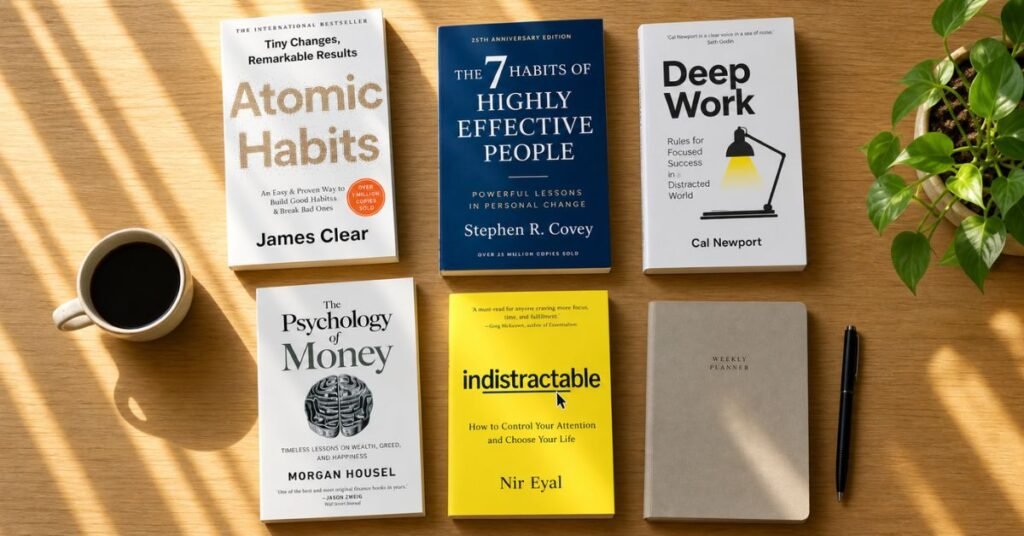
Discover the 10 best productivity books to improve focus, build better habits, master time management, and transform the way you work and achieve success.
Your to-do list has 47 items on it. Three tabs are open that you swore you’d “just check quickly.” You sat down to write one email twenty minutes ago and somehow ended up reorganizing your desktop icons.
If that sounds familiar, you’re not lazy, and you’re not broken. You’re just running on the same default systems most people run on — reactive, distraction-driven, motivation-dependent systems that were never built for how much competes for our attention today.
The good news is that some of the smartest researchers, coaches, and high performers on the planet have already spent years figuring out what actually works. They wrote it down. All you have to do is read it — and, more importantly, apply it.
This guide breaks down the 10 best productivity books that will change how you work, why they matter, who each one is best suited for, and how to actually turn the ideas into habits instead of letting them sit on a shelf.
Why Productivity Books Matter

It’s easy to be skeptical of “another productivity book.” But the right ones aren’t fluff — they’re distilled decades of research and real-world testing into frameworks you can use immediately.
Here’s what a genuinely good productivity book gives you:
Better decision-making. Instead of reacting to whatever feels urgent, you learn frameworks for deciding what actually deserves your time.
Improved focus. Books like Deep Work explain the mechanics of concentration, not just tell you to “focus more.”
Stronger habits. Understanding how habits form — and how to reshape them — is far more effective than relying on willpower alone.
Time management that actually sticks. Generic advice like “make a to-do list” rarely works long-term. These books offer systems that account for how humans actually behave.
Career advancement. Small shifts in how you prioritize and execute compound over years into meaningfully different career trajectories.
Personal growth beyond work. Many of these ideas — energy management, essentialism, single-tasking — spill over into better relationships, health, and overall life satisfaction.
The pattern across nearly every high performer, from founders to Olympic athletes, isn’t more hours worked. It’s better systems. These books are where those systems come from.
How We Selected These Books
Not every productivity book deserves a spot on a “best of” list. We evaluated each title based on:
- Practical advice — does it give you something to actually do, not just abstract inspiration?
- Scientific grounding — is it based on real research in psychology, behavioral science, or performance?
- Proven frameworks — has the method been tested and referenced across the productivity and business world?
- Long-term relevance — does the advice hold up years after publication, rather than chasing a trend?
- Influence — is this a book other experts, coaches, and authors regularly cite?
- Actionability — can a reader apply at least one idea within a day of finishing a chapter?
Books that were purely motivational without a practical system, or that relied on outdated or unsupported claims, didn’t make the cut.
Top 10 Productivity Books
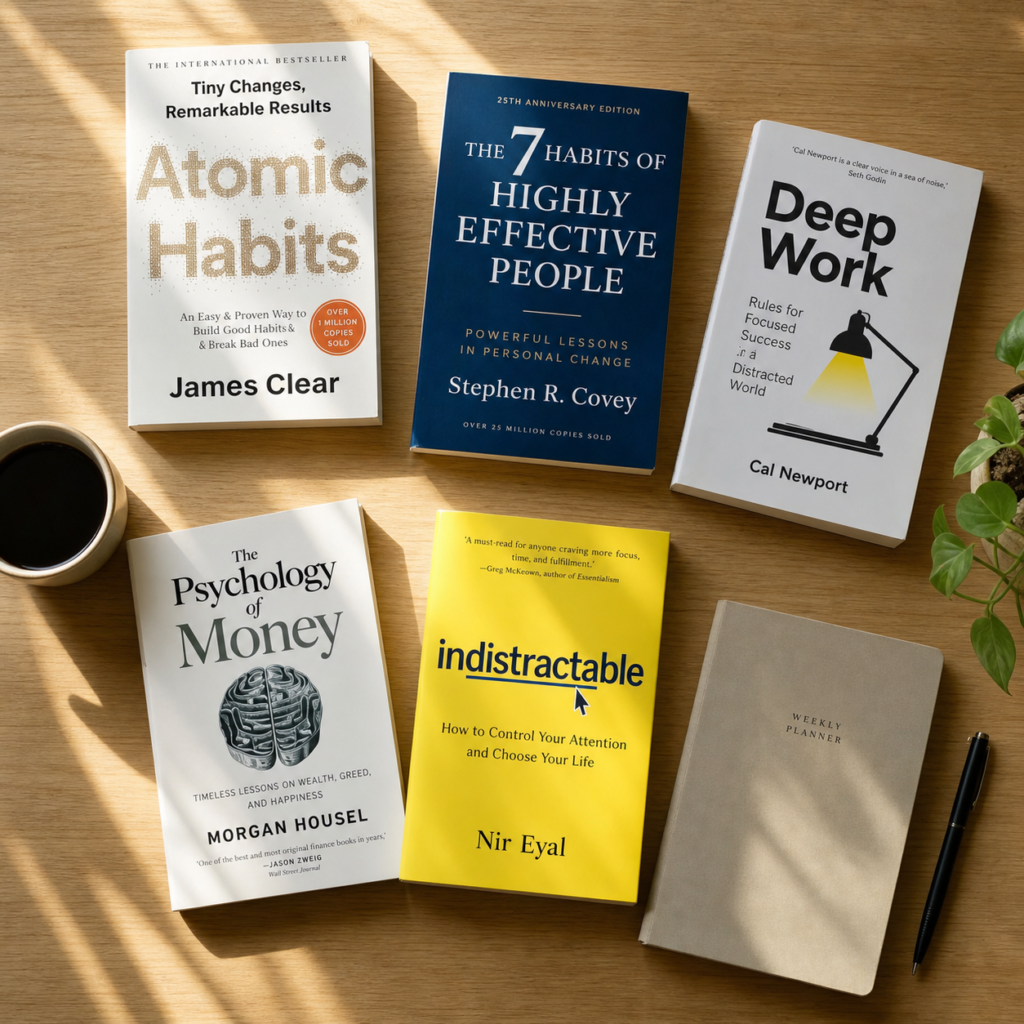
1. Deep Work
Author: Cal Newport Publication Year: 2016 Best For: Professionals and creatives who need long stretches of undistracted focus
Key Lessons: Cal Newport argues that the ability to focus without distraction on cognitively demanding tasks is becoming both rare and extremely valuable. He introduces practical strategies for scheduling and protecting “deep work” blocks, and explains why shallow, reactive work (email, meetings, notifications) crowds out the work that actually moves the needle.
Why You’ll Love It: Newport doesn’t just tell you focus matters — he explains the neuroscience and gives concrete rituals for building a deep work practice, including his famous “shutdown ritual” to mentally close out the workday.
Pros:
- Strong research backing
- Practical scheduling strategies (like time-blocking)
- Genuinely changes how you think about your calendar
Cons:
- Some strategies (like multi-day retreats) aren’t realistic for every job
- Can feel repetitive in the middle chapters
Favorite Quote: “The ability to perform deep work is becoming increasingly rare at exactly the same time it is becoming increasingly valuable in our economy.”
Key Takeaways: Schedule deep work like a non-negotiable appointment, minimize shallow work, and treat your attention as your most valuable professional asset.
Overall Rating: ⭐⭐⭐⭐⭐ (5/5)
2. Atomic Habits
Author: James Clear Publication Year: 2018 Best For: Anyone wanting to build better habits without relying on motivation
Key Lessons: James Clear breaks habit formation down into an actionable system built around identity, cues, cravings, responses, and rewards. His central idea — that small, 1% improvements compound dramatically over time — has become one of the most widely cited concepts in modern self-improvement.
Why You’ll Love It: It’s practical to an unusual degree. Clear gives specific techniques (habit stacking, the two-minute rule, environment design) that you can implement the same day you read them.
Pros:
- Extremely actionable, step-by-step system
- Clear, simple writing that avoids jargon
- Works for nearly any habit, not just productivity
Cons:
- Some concepts overlap with earlier habit-science books
- Light on nuance for complex, deeply ingrained habits
Favorite Quote: “You do not rise to the level of your goals. You fall to the level of your systems.”
Key Takeaways: Build systems, not just goals. Make good habits obvious, attractive, easy, and satisfying — and do the opposite for bad ones.
Overall Rating: ⭐⭐⭐⭐⭐ (5/5)
3. Getting Things Done
Author: David Allen Publication Year: 2001 (updated edition 2015) Best For: People overwhelmed by scattered tasks, ideas, and commitments
Key Lessons: David Allen’s GTD method is built around a simple but powerful idea: your brain is for having ideas, not holding them. He offers a full system for capturing every task and commitment, clarifying what each one actually requires, organizing it, and reviewing it regularly so nothing falls through the cracks.
Why You’ll Love It: If your mind constantly feels cluttered with half-remembered tasks, GTD offers genuine mental relief. It’s less about motivation and more about building a trustworthy external system.
Pros:
- One of the most complete task-management systems available
- Reduces mental clutter and anxiety around forgotten tasks
- Works well alongside digital tools like task managers and calendars
Cons:
- The system has a learning curve and requires upfront setup time
- Can feel overly rigid for people who prefer simpler systems
Favorite Quote: “Your mind is for having ideas, not holding them.”
Key Takeaways: Capture everything, clarify next actions, organize by context, and review your system regularly to keep it trustworthy.
Overall Rating: ⭐⭐⭐⭐ (4/5)
4. Essentialism
Author: Greg McKeown Publication Year: 2014 Best For: People who say yes to too much and feel spread thin
Key Lessons: Greg McKeown makes the case for doing less, but better. Essentialism is the disciplined pursuit of only what truly matters, cutting out the “trivial many” to make room for the “vital few.” It’s as much a mindset shift as a productivity system.
Why You’ll Love It: If your problem isn’t a lack of systems but a lack of boundaries, this book reframes productivity as a filtering problem, not a doing-more problem.
Pros:
- Powerful reframe for chronic overcommitment
- Practical guidance on saying no gracefully
- Philosophical without being impractical
Cons:
- Less concrete, step-by-step than books like GTD or Atomic Habits
- Some readers find the anecdotes repetitive
Favorite Quote: “If you don’t prioritize your life, someone else will.”
Key Takeaways: Ruthlessly evaluate what deserves your time, learn to say no without guilt, and protect space for what truly matters.
Overall Rating: ⭐⭐⭐⭐ (4/5)
5. The 7 Habits of Highly Effective People
Author: Stephen R. Covey Publication Year: 1989 Best For: Readers wanting a comprehensive, character-based approach to effectiveness
Key Lessons: Covey’s classic organizes effectiveness around seven interconnected habits, moving from personal responsibility (“Be Proactive”) to interpersonal effectiveness (“Think Win-Win”) to continuous growth (“Sharpen the Saw”). It’s less a productivity hack book and more a full philosophy of effective living.
Why You’ll Love It: This is the book many modern productivity authors build on. Understanding it gives useful context for nearly everything else on this list.
Pros:
- Timeless, foundational framework
- Balances personal effectiveness with relationships and leadership
- Widely referenced across business and self-help literature
Cons:
- Denser and more philosophical than newer, punchier productivity books
- Some examples feel dated
Favorite Quote: “Begin with the end in mind.”
Key Takeaways: Effectiveness starts with personal responsibility, requires clear priorities, and depends on strong relationships — not just efficient task management.
Overall Rating: ⭐⭐⭐⭐ (4/5)
6. Eat That Frog!
Author: Brian Tracy Publication Year: 2001 (updated editions since) Best For: Chronic procrastinators who need a quick, no-nonsense system
Key Lessons: Tracy’s core idea is simple: identify your most important, most difficult task (your “frog”) and do it first thing, before anything else can distract you. The book is packed with short, actionable chapters, each offering a specific tactic for beating procrastination.
Why You’ll Love It: It’s short, direct, and immediately useful. If longer books feel overwhelming, this one respects your time.
Pros:
- Fast read with immediately usable tips
- Simple, memorable central metaphor
- Great for procrastination-specific struggles
Cons:
- Less depth than research-heavy books like Atomic Habits
- Some tactics feel like a list rather than a unified system
Favorite Quote: “Eat a live frog first thing in the morning, and nothing worse will happen to you the rest of the day.”
Key Takeaways: Tackle your hardest, most important task first, and don’t let smaller, easier tasks eat your peak-energy hours.
Overall Rating: ⭐⭐⭐⭐ (4/5)
7. The One Thing
Author: Gary Keller & Jay Papasan Publication Year: 2013 Best For: People juggling too many priorities who need radical focus
Key Lessons: The central question of the book — “What’s the ONE thing I can do such that by doing it, everything else becomes easier or unnecessary?” — is designed to cut through competing priorities and force genuine focus on what matters most.
Why You’ll Love It: It’s a simple mental model you can apply to any goal, project, or day, cutting decision fatigue significantly.
Pros:
- Simple, repeatable question you can apply anywhere
- Backed by goal-setting and focus research
- Useful at both the daily and long-term planning level
Cons:
- The single-question framework can feel oversimplified for complex projects
- Some sections repeat the core idea more than necessary
Favorite Quote: “What’s the ONE Thing I can do such that by doing it everything else will be easier or unnecessary?”
Key Takeaways: Narrow your focus to a single priority at a time, and build your schedule around protecting time for that priority first.
Overall Rating: ⭐⭐⭐⭐ (4/5)
8. Make Time
Author: Jake Knapp & John Zeratsky Publication Year: 2018 Best For: People who want a flexible, experiment-based approach rather than a rigid system
Key Lessons: Written by two former Google designers, Make Time offers a menu of 80+ tactics organized around four steps: highlight a daily priority, create laser focus, boost energy, and reflect. Rather than prescribing one system, it encourages readers to experiment and find what fits their life.
Why You’ll Love It: If you’ve tried rigid systems before and abandoned them, this book’s flexible, pick-and-choose structure is refreshing and realistic.
Pros:
- Highly practical, bite-sized tactics
- Encourages personalization rather than one-size-fits-all rules
- Written by people with real tech-industry experience
Cons:
- The sheer number of tactics can feel overwhelming to sort through
- Less of a unified philosophy than books like Essentialism
Favorite Quote: “Highlight, Laser, Energize, Reflect.”
Key Takeaways: Pick one daily highlight to prioritize, minimize distractions to stay in a focused state, and manage your energy as carefully as your time.
Overall Rating: ⭐⭐⭐⭐ (4/5)
9. Indistractable
Author: Nir Eyal Publication Year: 2019 Best For: Anyone struggling with phone addiction, notifications, and digital distraction
Key Lessons: Nir Eyal, who previously wrote about what makes products habit-forming, flips the script in Indistractable, offering a framework for mastering internal triggers (boredom, anxiety, loneliness) and external triggers (notifications, open-plan offices) that pull us away from what we intend to do.
Why You’ll Love It: Unlike books that simply say “put your phone away,” this one digs into the psychological root of distraction, which makes the advice stick longer.
Pros:
- Addresses the root causes of distraction, not just symptoms
- Practical tools for handling internal triggers like boredom and stress
- Relevant for both work and personal life
Cons:
- Some tactical advice overlaps with other digital wellness books
- A few sections lean more theoretical than actionable
Favorite Quote: “If you don’t plan your day, someone else will hijack it for you.”
Key Takeaways: Distraction often starts internally, not externally — manage discomfort and boredom directly instead of just blocking apps.
Overall Rating: ⭐⭐⭐⭐ (4/5)
10. The Power of Full Engagement
Author: Jim Loehr & Tony Schwartz Publication Year: 2003 Best For: People who manage their calendar well but still feel exhausted
Key Lessons: Loehr and Schwartz argue that energy, not time, is the real currency of high performance. Drawing on their work with elite athletes, they introduce the idea of managing physical, emotional, mental, and spiritual energy through cycles of stress and recovery, rather than just squeezing more hours out of the day.
Why You’ll Love It: This book reframes productivity entirely — if you’ve optimized your schedule but still feel drained, energy management might be the missing piece.
Pros:
- Unique angle focused on energy rather than time
- Backed by work with elite performers and athletes
- Addresses burnout directly, which many productivity books ignore
Cons:
- Written for a corporate audience, so some examples feel dated
- Less tactical than habit- or task-focused books
Favorite Quote: “Energy, not time, is the fundamental currency of high performance.”
Key Takeaways: Build in deliberate recovery, not just relentless output, and manage your energy across physical, emotional, mental, and spiritual dimensions.
Overall Rating: ⭐⭐⭐⭐ (4/5)

Comparison Table
| Book | Best For | Difficulty Level | Main Topic | Key Benefit | Rating |
| Deep Work | Professionals needing focus | Moderate | Concentration | Protects time for high-value work | ⭐⭐⭐⭐⭐ |
| Atomic Habits | Anyone building habits | Easy | Habit formation | Small changes compound over time | ⭐⭐⭐⭐⭐ |
| Getting Things Done | Overwhelmed task-jugglers | Moderate–Hard | Task management | Clears mental clutter | ⭐⭐⭐⭐ |
| Essentialism | Chronic over-committers | Easy | Prioritization | Teaches disciplined focus | ⭐⭐⭐⭐ |
| The 7 Habits | Holistic effectiveness seekers | Moderate | Character & effectiveness | Foundational life framework | ⭐⭐⭐⭐ |
| Eat That Frog! | Procrastinators | Easy | Task prioritization | Fast, actionable tactics | ⭐⭐⭐⭐ |
| The One Thing | Multi-priority jugglers | Easy | Focus | Simplifies decision-making | ⭐⭐⭐⭐ |
| Make Time | Flexible experimenters | Easy | Daily habits | Customizable tactics | ⭐⭐⭐⭐ |
| Indistractable | Digitally distracted readers | Moderate | Distraction management | Tackles root causes of distraction | ⭐⭐⭐⭐ |
| The Power of Full Engagement | Burned-out high achievers | Moderate | Energy management | Prevents burnout | ⭐⭐⭐⭐ |
Which Book Is Right for You?

Students — Start with Atomic Habits for building consistent study habits, then move to Eat That Frog! to beat procrastination on assignments.
Entrepreneurs — The One Thing and Essentialism help cut through the constant pull of competing priorities that comes with running a business.
Remote workers — Deep Work and Indistractable directly address the unique focus challenges of working from home with endless digital distractions nearby.
Managers and leaders — The 7 Habits of Highly Effective People offers the most complete framework for leading both yourself and others.
Busy professionals — Make Time and Getting Things Done both offer systems for managing a packed schedule without letting things fall through the cracks.
Creatives — Deep Work is especially valuable for protecting the long, uninterrupted focus creative work requires.
Beginners to productivity reading — Start with Atomic Habits or Eat That Frog!, both accessible and immediately actionable.
Advanced readers — The Power of Full Engagement and The 7 Habits offer more nuanced, holistic frameworks for those who’ve already tried the basics.
Common Productivity Lessons Across These Books
Despite different authors and decades of publication, several themes repeat across nearly every book on this list:
Habit stacking. Linking new habits to existing routines (popularized in Atomic Habits) makes new behaviors far more likely to stick.
Deep work over shallow work. Nearly every book acknowledges that not all work is equal — protecting time for high-value tasks matters more than simply staying busy.
Time blocking. Scheduling specific blocks for specific tasks, rather than working from an open-ended to-do list, shows up in Deep Work, Make Time, and Getting Things Done alike.
Prioritization over sheer effort. Essentialism, The One Thing, and Eat That Frog! all argue that doing the right thing matters more than doing more things.
Systems over goals. Atomic Habits and The 7 Habits both emphasize building repeatable systems rather than relying on willpower or one-time motivation.
Energy management. The Power of Full Engagement stands out here, but even books focused on time acknowledge that tired, depleted people can’t execute well regardless of their schedule.
Eliminating distractions. Indistractable dives deepest into this, but nearly every author acknowledges that unmanaged distraction quietly destroys productivity.
How to Apply What You Read
Reading a productivity book and actually changing your behavior are two very different things. Here’s how to close that gap:
- Read in short, consistent sessions — even 20 minutes a day adds up and keeps ideas fresh.
- Take notes as you go, rather than waiting until you finish the book.
- Highlight or bookmark ideas you want to revisit, not just interesting passages.
- Create a one-page action plan after finishing each book — three concrete changes you’ll make.
- Implement one habit at a time. Trying to overhaul your entire routine at once rarely sticks.
- Review your progress weekly. Ask what worked, what didn’t, and what needs adjusting.
- Revisit the book after a month. Ideas land differently once you’ve tried applying them.
Frequently Asked Questions
What is the best productivity book for beginners?
Atomic Habits is widely considered the most accessible starting point, offering a simple, practical framework that doesn’t require prior knowledge of productivity systems.
Which book improves focus the most?
Deep Work by Cal Newport is specifically built around the science and practice of sustained, distraction-free concentration.
Are productivity books worth reading?
Yes, when you apply the ideas rather than just consuming them. The value comes from implementation, not the reading itself.
Which book helps stop procrastination?
Eat That Frog! is designed specifically around tackling procrastination by prioritizing your hardest task first thing each day.
What book teaches better habits?
Atomic Habits is the clearest, most research-backed guide to building and breaking habits available today.
Which productivity book is best for entrepreneurs?
Essentialism and The One Thing are particularly useful for entrepreneurs juggling many competing priorities and limited time.
How many productivity books should I read each year?
There’s no fixed number, but quality of implementation matters more than quantity. Reading two or three books deeply and applying their lessons beats skimming ten.
Can productivity books improve work performance?
Yes, when the strategies are actually implemented consistently. The books alone don’t create change — applied habits do.
Which book is best for time management?
Getting Things Done offers the most complete system for managing tasks, commitments, and time in a structured way.
Should I read or listen to productivity books?
Both work well. Audiobooks are great for commutes or workouts, while physical or e-books make note-taking and highlighting easier for deeper study.
Expert Tips
- Apply one lesson before starting your next book. Momentum matters more than volume.
- Build systems instead of chasing motivation. Motivation fades; systems don’t rely on how you feel that day.
- Schedule deep work sessions like real appointments. If it’s not on the calendar, it likely won’t happen.
- Protect your energy, not just your time. A full calendar with no recovery leads to burnout, not productivity.
- Review your goals weekly, not just at the start of the year.
- Say no more often. Every yes to something unimportant is a no to something that matters.
- Batch similar tasks together to reduce context-switching costs.
- Track what actually works for you, not just what worked for the author.
- Revisit key books periodically. Ideas often land differently the second time, once you have real experience to compare them against.
- Pair reading with action, always. A highlighted book with no behavior change is just an expensive bookmark holder.
Conclusion
You don’t need to read all 10 of these books to transform how you work. You need to read one, apply its central idea consistently, and let that single shift build momentum for the next.
If distraction is your biggest struggle, start with Deep Work or Indistractable. If your habits feel inconsistent, start with Atomic Habits. If you’re saying yes to too much, start with Essentialism.
Productivity isn’t about consuming more books, tools, or hacks — it’s about applying fewer ideas more consistently. Pick one. Start today.
Looking to build out your full productivity toolkit? Check out our guides on the best time management apps, daily habits of highly successful people, and AI tools that boost productivity to keep building momentum.
This post may contain affiliate links. If you purchase through these links, we may earn a small commission at no additional cost to you.