
You’ve built this morning routine before. Probably more than once. Day one, you were up before the alarm, journaling with a cup of coffee, feeling like the main character of a productivity video. Day four, you hit snooze twice and skipped the whole thing. By day ten, it was like it never existed — just another 5 a.m. routine that looked great in a Pinterest infographic and lasted less time than the coffee took to brew.
Here’s the part almost nobody tells you: that’s not a willpower problem. It’s a design problem. Most morning routines are copied wholesale from someone else’s life — someone with a different job, different sleep needs, different chronotype, sometimes a different decade of life entirely — and then dropped onto a Tuesday with zero backup plan for the mornings that go wrong. This guide is about building the version that’s actually yours, one that survives bad sleep, busy weeks, and the inevitable morning you oversleep.

Why Most Morning Routines Fail (It’s Not You)
They’re copied, not designed. A routine built for a freelancer with no kids rarely survives contact with a 6:30 a.m. school run. The routine itself isn’t wrong — it’s just wrong for your life.
They start too big. Meditation, journaling, cold shower, workout, reading, and a “mindful” breakfast, all starting Monday, is six new habits at once. Behavioral research on habit formation consistently shows that stacking multiple new behaviors simultaneously dramatically increases the odds all of them collapse together, because willpower is a shared, limited resource — not five separate tanks.
They ignore the night before. A morning routine doesn’t start when the alarm goes off. It starts the night before, in what time you actually went to bed and what you already decided to do before your brain is even fully online.
They have no recovery plan. Every routine gets missed eventually — a sick kid, a bad night’s sleep, a late flight. Routines that don’t survive a missed day usually die on the first one, because missing once quietly turns into “well, I already broke it” and the whole thing gets abandoned.

Step 1: Work With Your Chronotype, Not Against It
Not everyone is wired to thrive at 5 a.m., and forcing it is one of the fastest ways to sabotage a routine before it starts. Chronotype — your body’s natural sleep-wake tendency — is influenced by genetics, and pushing hard against it usually just produces a groggy, resentful version of whatever routine you were hoping for.
If you’re naturally a night owl, an earlier wake-up can still work, but it needs to be built gradually (15 minutes earlier every few days, not a sudden 5 a.m. jump) and paired with an equally gradual earlier bedtime. If mornings will never be your peak energy window no matter what you do, the better move is designing a routine that’s short, calm, and functional — getting you out the door grounded rather than trying to cram in your most demanding tasks before 7 a.m.
Step 2: Design the Night Before
The single highest-leverage change most people can make isn’t anything that happens in the morning at all — it’s what happens the night before.
Lay out tomorrow’s plan the night before: what you’re wearing, what’s for breakfast, the first task you’ll tackle at work. This does two things. It removes decisions from a time of day when your brain has the least glucose and willpower available (right after waking), and it closes what’s called the Zeigarnik effect loop — the mental itch of unfinished, undecided things that quietly drains focus until it’s resolved.
This is closely tied to the same mechanics behind beating procrastination. A huge amount of morning avoidance — hitting snooze, scrolling instead of starting — isn’t laziness, it’s the brain deferring a decision it doesn’t want to make yet. If mornings tend to spiral into avoidance before you’ve even started your day, it’s worth reading science-backed techniques for stopping procrastination, because several of the same low-friction tricks that get people started on hard tasks also work for getting people out of bed.
Step 3: Build Through Habit Stacking, Not Willpower
Habit stacking is one of the most reliable, research-supported ways to build a new routine: attach a new, small habit to an existing one you already do automatically, rather than trying to summon willpower from nothing every single day.
The formula is simple: “After I [existing habit], I will [new habit].” After I pour my coffee, I will write down three priorities for the day. After I brush my teeth, I will do two minutes of stretching. The existing habit becomes the trigger, so you’re not relying on memory or motivation — you’re relying on a chain reaction that’s already wired into your day.
Start with exactly one stacked habit. Let it run on autopilot for one to two weeks before adding a second link to the chain. This is slower than most morning-routine content recommends, and it’s also the version that’s still running six months from now instead of six days.
Building this kind of consistency without relying purely on grit is really a self-discipline skill, and it’s a learnable one rather than a fixed trait some people have and others don’t. If your past attempts have collapsed the moment motivation dipped, it’s worth reading how to build self-discipline the sustainable way alongside this guide, since the systems that make a workout habit or a writing habit stick are the same ones that make a morning routine survive a bad week.
Step 4: Keep It Short Enough to Survive a Bad Day
A common trap is building a morning routine that only works on a perfect day — full night’s sleep, no early meetings, nothing urgent waiting in the inbox. That routine will get skipped constantly, because perfect days are rare.
The fix is designing a “minimum viable routine” — the smallest version that still counts as a win, doable in five minutes flat on your worst morning. If your full routine is 45 minutes of movement, journaling, and reading, your minimum version might be just: drink a glass of water and write one line in a journal. On good days, do the full version. On rough days, the five-minute version keeps the habit alive instead of breaking the streak entirely — and an unbroken streak, even a minimal one, is far easier to rebuild from than starting completely over.
Step 5: Track It Without Making Tracking a Chore
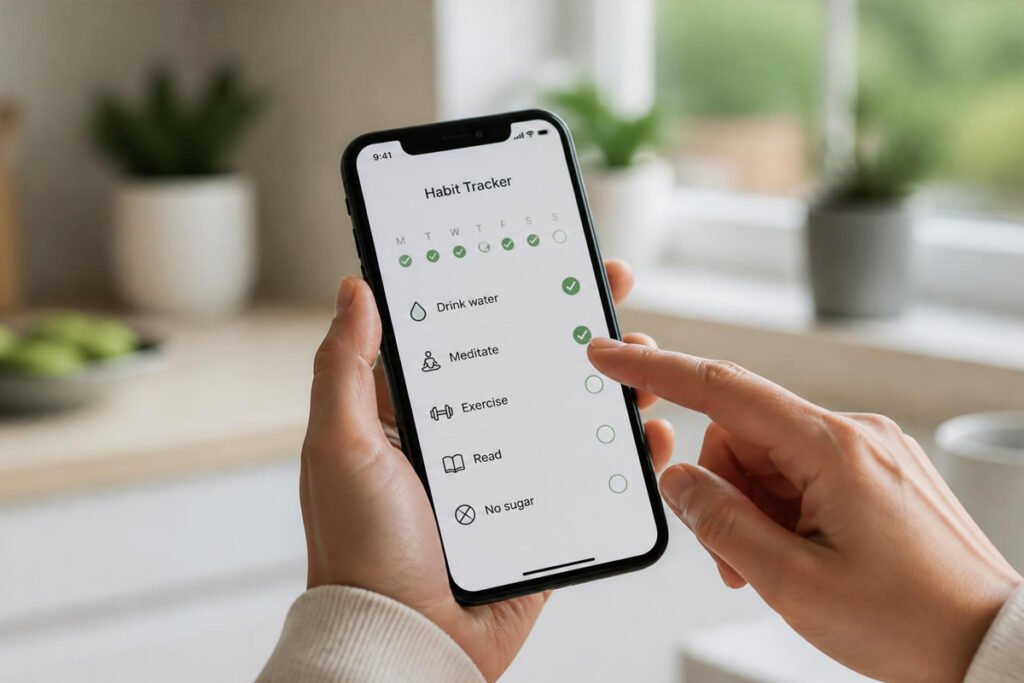
Visible progress is one of the strongest psychological drivers of habit consistency — seeing a streak, however small, creates a pull to protect it. But manually logging a habit every day adds friction, and friction is exactly what kills routines in their fragile first few weeks.
This is where letting a tool absorb the tracking load helps far more than it might seem. Instead of holding your streak in your head or a scattered note somewhere, a lightweight tracker handles the reminders and the visual progress for you, which frees up the mental energy you’d otherwise spend just remembering to check in. This roundup of AI habit-tracking apps to build better routines is a good place to find one that fits without adding another task to your morning.
Step 6: Use the First Few Minutes to Process, Not Just Perform
Many morning routines are built entirely around output — exercise, to-do lists, productivity. There’s real value in also using a few minutes to simply check in with yourself before the day’s demands take over, especially if mornings tend to start with a low-grade sense of dread or overwhelm.
A minute or two of writing — what’s actually on your mind, what you’re dreading, what you’re looking forward to — does more for mental clarity than it seems like it should, because it moves vague anxiety out of your head and onto a page where it’s easier to see clearly and let go of. If starting from a blank page feels like one more decision you don’t have energy for first thing in the morning, a prompt-based tool can lower that barrier considerably; this list of the best AI journaling apps for self-reflection covers several built specifically for quick, low-effort morning check-ins.
Step 7: Plan for the Days It Falls Apart
Every routine gets missed. What actually determines whether a morning routine survives long-term isn’t whether you miss a day — it’s how you respond to missing it.
The most damaging pattern isn’t the missed day itself; it’s the all-or-nothing thinking that follows it (“I already broke my streak, so what’s the point this week”). This is where building genuine resilience matters as much as building the routine itself — the ability to have a rough morning, a rough week even, and come back to the routine without treating the lapse as proof the whole thing failed. If your history with routines involves this kind of one-bad-day collapse, it’s worth reading about how to build mental resilience, since the mindset that helps people bounce back from bigger setbacks is the same one that keeps a morning routine alive through an ordinary bad week.

A Sample Framework (Adapt, Don’t Copy)
Since the whole point of this guide is that copied routines fail, treat this as a starting skeleton rather than a script:
- Night before (5 minutes): Lay out clothes, write down tomorrow’s top priority, set a consistent bedtime alarm.
- Wake-up (2 minutes): Feet on the floor, glass of water, no phone for the first few minutes.
- Anchor habit (5–10 minutes): One stacked habit tied to something you already do — coffee + three-line journal entry, or brushing teeth + two minutes of stretching.
- Minimum viable version (2 minutes): Water and one journal line — this is your fallback on any day the full version isn’t happening.
- Weekly check-in (5 minutes, once a week): Look back at what actually happened versus the plan, and adjust — not to judge yourself, just to notice what’s realistically working.
How to Adjust the Routine as Your Life Changes
A routine that works during a quiet month often needs to flex during a busy one, and treating it as adjustable rather than sacred is what actually keeps people consistent over years rather than weeks.
During high-stress stretches — a big deadline, a new baby, a family emergency — the right move is usually shrinking the routine down to its minimum viable version and holding steady there, rather than abandoning it entirely because the full version isn’t realistic. A five-minute routine kept every day beats a forty-five-minute routine attempted twice and abandoned.
During calmer stretches, it’s worth periodically asking whether the routine still reflects what you actually need. A routine built six months ago around getting to the gym before a demanding job might need to shift entirely if the job or the goals underneath it have changed. Revisiting it every season, rather than assuming the original version is permanent, keeps it useful instead of becoming just another obligation you’re maintaining out of habit rather than benefit.
Common Mistakes That Quietly Sabotage Morning Routines
A few patterns show up again and again in people who’ve tried and failed at morning routines multiple times — worth checking against your own history before starting a new attempt.
Relying on motivation instead of environment. Motivation is highest right after you decide to change something and lowest on an ordinary Tuesday two weeks later — which is exactly when most routines quietly die. Environment design beats motivation almost every time: phone charging outside the bedroom so it can’t be the first thing you reach for, workout clothes laid out where you’ll trip over them, journal already open on the counter. Removing friction from the good choice does more than any amount of willpower.
Treating the routine as fixed forever. Life changes — new job, new baby, new sleep schedule — and a routine built for a previous season of life will naturally stop fitting. Revisiting and adjusting the routine every few months isn’t failure, it’s maintenance. The goal is a routine that evolves with you, not one you’re white-knuckling to keep identical to how it looked on day one.
Comparing your routine to someone else’s highlight reel. Social media morning-routine content is almost always the most photogenic 5% of someone’s actual mornings, filmed on a day everything went right. Comparing your real, occasionally messy mornings to someone’s curated montage is a losing game that erodes motivation for no real benefit.
Adding accountability too late. Habits are far more likely to stick when someone else — a friend, a partner, even an app — has visibility into whether you did them. Building in light accountability from week one, rather than waiting until motivation fades and you suddenly need it, keeps the early, fragile weeks of a new routine from collapsing unnoticed.
Frequently Asked Questions
How long does it take for a morning routine to actually stick? Research on habit formation generally points to somewhere between three weeks and a few months, depending on the complexity of the habit and how consistently it’s repeated — there’s no fixed universal number, and simpler habits stacked onto existing routines tend to solidify faster than complex, multi-step ones.
Can I still build a good morning routine if I work night shifts or irregular hours? Yes — the underlying principles (consistency, habit stacking, a night-before setup, a minimum viable version) apply regardless of what time your “morning” actually falls at. The routine should anchor to your first waking hour, not the clock, so a night-shift worker’s version of this guide simply shifts the whole framework to whenever their day begins.
What if I keep sleeping through my alarm? This is often a night-routine problem disguised as a morning problem. Inconsistent bedtimes, screens right before sleep, and caffeine too late in the day all disrupt the sleep quality that makes waking up hard, no matter how motivated you are.
Do I need to wake up at 5 a.m. for a routine to count? No. A morning routine’s value comes from consistency and intentionality, not the specific clock time. A calm, well-designed 7 a.m. routine that survives real life beats an ambitious 5 a.m. one that collapses within two weeks.
What’s the single best habit to start with? Whichever one requires the least willpower to start and stacks most naturally onto something you already do automatically — for most people, that’s something small tied to the first thing they already do every morning, like making coffee or brushing their teeth.
Moving Forward
The goal was never a perfect morning. It’s a routine ordinary enough to survive an ordinary week — the sleepy ones, the rushed ones, the ones where nothing goes according to plan. Start with one small, stacked habit. Give it two weeks before judging it. Build the rest slowly from there. And the next time a morning falls apart completely, remember that the routine isn’t broken — it’s just waiting for tomorrow to try again.