
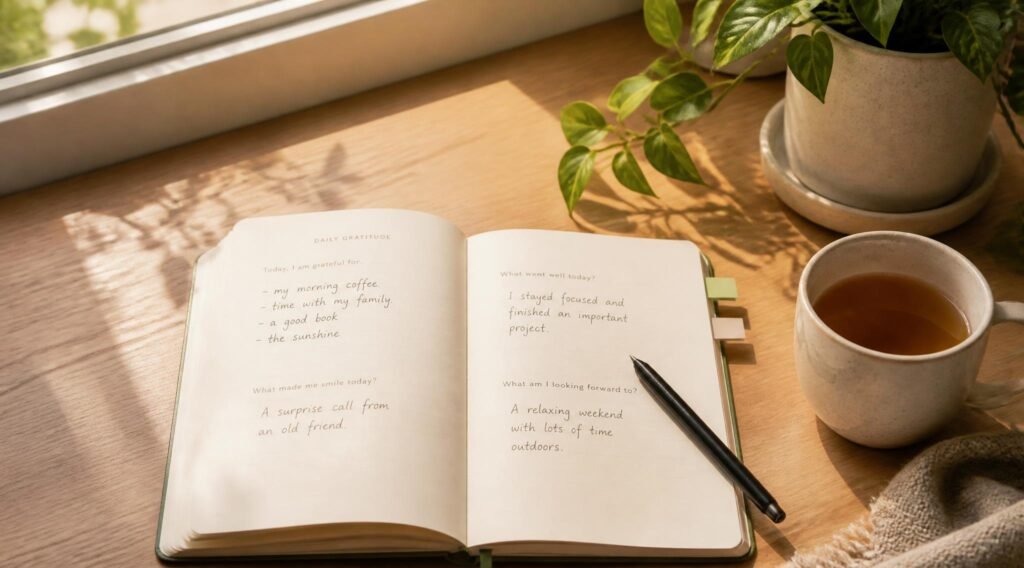
You bought the journal with the best intentions. The cover was beautiful, the first page felt full of promise, and you wrote three heartfelt lines about your family, your health and your morning coffee. Then life got loud. By week two the journal was under a pile of mail, and the guilt of an unfinished habit was sitting right next to it.
That pattern is not a character flaw. Most people quit because the journal they picked does not match how they actually think, write or live. A blank page with no prompts is paralysing for some people. A heavily structured daily planner feels like homework for others. Choosing from the best gratitude journals is really about finding the one whose format you will still open on a tired Thursday night.
This guide compares five proven options, explains who each one suits, and shows you how to turn a notebook into a habit that lasts. If you tend to overthink everything, you may also like our piece on why overthinking is ruining your happiness, because gratitude practice is one of the simplest ways to interrupt that loop. And if you want the bigger picture of what matters, read these 15 powerful life lessons most people learn too late.
Quick Answer
The best gratitude journal depends on how much time and structure you want. Busy people do well with a short, fixed format such as The Five Minute Journal or a one-minute daily journal. Beginners who freeze at a blank page do better with a prompt-based journal like Good Days Start With Gratitude. Reflective writers will enjoy the creative prompts in Tiny Buddha’s Gratitude Journal, while minimalists can keep a one-sentence-a-day record for five years. The best journal is the one you will actually open every day.
Table of Contents
- What Is a Gratitude Journal and How Does It Work?
- How to Choose the Best Gratitude Journal
- The 5 Best Gratitude Journals Reviewed
- Comparison Table
- Best Gratitude Journals for Different Needs
- How to Start a Gratitude Journal and Keep It Going
- Common Mistakes to Avoid
- Expert Tips
- Final Verdict
- Frequently Asked Questions
[IMAGE 2 — Tools Required | Alt text: “gratitude journal, pen, sticky tabs and tea arranged on a table for a daily gratitude journal routine”]
What Is a Gratitude Journal and How Does It Work?
A gratitude journal is a notebook where you regularly write down things you appreciate. That might be a person, a small win, a meal, a moment of quiet, or something hard that taught you a lesson. The point is not to force positivity. The point is to train your attention so it notices what is going right as well as what is going wrong.
Our brains are wired to scan for problems, which is useful for survival and exhausting for daily life. Writing a few specific appreciations each day gives your attention a counterweight. Research summarised by Harvard Health suggests that people who regularly practise gratitude report feeling happier and more satisfied with life, which you can read more about in Harvard Health’s overview of giving thanks.
A gratitude journal works best when it is specific. “I’m grateful for my sister” is pleasant. “I’m grateful my sister called just to ask how my interview went” is memorable. Specific entries make you relive the moment, and that is where the mood shift comes from.
It also pairs well with other calming habits. If you already use mindfulness tools, our guide to the best meditation apps for stress management is a natural companion to a nightly gratitude entry.
How to Choose the Best Gratitude Journal
Before you buy, ask yourself three short questions.
1. How much time do I really have? If the honest answer is two minutes, avoid journals with long daily pages. A format that takes one to five minutes has a much better survival rate than one that asks for a full page.
2. Do I want prompts or freedom? Prompts remove the “what do I write?” problem. Open pages suit people who like to doodle, rant or write long reflections. Be honest about which one describes you.
3. Will I carry it or leave it at home? A slim, lightweight journal fits in a bag. A larger hardcover works better as a bedside book. Paper quality also matters if you like fountain pens or gel pens.
Also look at the structure over time. Some journals run for a fixed 90 days or a year, which gives you a clear finish line. Others are undated so you can skip days without guilt. If you are comparing gratitude journals with goal-focused notebooks, our roundup of the best planners and journals for goal setting and productivity explains how the two categories differ.
Note: formats, editions and prices change often. Check the current listing before you buy.
The 5 Best Gratitude Journals Reviewed
1. The Five Minute Journal (Intelligent Change)
Overview: The Five Minute Journal is one of the most recognised daily gratitude journals, and its popularity comes from a simple split. You spend a couple of minutes in the morning and a couple more in the evening. In the morning you list what you are grateful for, what would make the day great, and a daily affirmation. In the evening you record three good things that happened and how you could have made the day even better. The fixed routine builds a before-and-after rhythm that many people find easy to repeat.
Key Features:
- Morning and evening prompts on one page
- Same questions every day, so there is nothing to decide
- Space for a daily affirmation
- Dated, structured layout
Best For: Busy professionals who want a quick, predictable routine.
Pros: ✅ Very fast to complete ✅ Strong habit structure ✅ Works well alongside a morning routine
Cons: ❌ Repeated prompts can feel stale over time ❌ Dated pages make missed days visible
Our Verdict: If your biggest obstacle is time, this is the safest starting point. Pair it with the ideas in our guide to building a morning routine that actually sticks and keep the journal next to your coffee or toothbrush so it becomes part of the routine rather than an extra task.
2. Good Days Start With Gratitude
Overview: Good Days Start With Gratitude is a guided journal that leans on weekly prompts and encouraging quotes. It is popular with beginners because it answers the question that kills most journaling habits: “What do I write today?” The prompts nudge you to notice relationships, small pleasures and personal strengths, rather than listing the same three items repeatedly.
Key Features:
- Guided prompts that change through the journal
- Inspirational quotes for motivation
- Compact size that is easy to carry
- A gentle tone that suits first-time journalers
Best For: Complete beginners who want guidance without pressure.
Pros: ✅ Removes the blank-page problem ✅ Variety keeps entries fresh ✅ Friendly, non-clinical tone
Cons: ❌ Less room for long, free-form reflection ❌ Prompts may feel too gentle for experienced journalers
Our Verdict: This is the one we would hand to a friend who says “I’ve never kept a journal.” It pairs nicely with the habit-stacking approach in our list of 20 tiny habits that can transform your life.
3. The One-Minute Gratitude Journal
Overview: As the name suggests, this journal is built around speed. Each daily entry is short, designed to be finished in about a minute. That makes it one of the most forgiving options for people who have tried and failed to keep a journal. A short entry beats a perfect entry you never write.
Key Features:
- Very short daily pages
- Minimal instructions
- Light, portable format
- Low pressure if you miss a day
Best For: People with packed schedules or a history of abandoning journals.
Pros: ✅ Extremely low time cost ✅ Easy to restart after a break ✅ Good first journal
Cons: ❌ Limited depth ❌ Not ideal if you want to explore feelings in detail
Our Verdict: Think of this as the entry-level habit builder. Combine it with a small daily routine from our list of 10 daily habits that will change your life in 30 days, then upgrade to a deeper journal once the habit is solid.
[IMAGE 3 — Before/After | Alt text: “best gratitude journals before and after: a cluttered notebook on the left and a neat daily gratitude journal page on the right”]
4. Tiny Buddha’s Gratitude Journal
Overview: Created by Lori Deschene, the founder of the Tiny Buddha community, this journal mixes prompts, quotes and room to express yourself. It leans toward creativity and self-reflection rather than pure list-making. If you like to write a few sentences, sketch or colour, it gives you more space than the speed-focused options above.
Key Features:
- Thoughtful prompts for reflection
- Room for free writing and creative expression
- Wisdom-style quotes throughout
- Suited to a slower, calmer ritual
Best For: Reflective people who enjoy writing and want to understand themselves better.
Pros: ✅ Rich, meaningful prompts ✅ Space for creativity ✅ Encourages self-awareness
Cons: ❌ Takes more time ❌ Might feel overwhelming if you are short on energy
Our Verdict: A good fit for anyone working on confidence and self-worth. Combine it with our guide on how to build self-confidence and use the prompts to notice what you already do well.
5. The Happiness Project One-Sentence Journal: A Five-Year Record
Overview: Gretchen Rubin’s one-sentence journal takes a different approach. Instead of a long daily entry, you write a single sentence for each day. The pages are organised by date across five years, so on each date you can see what you wrote in previous years. That long view is what makes it powerful: you start to notice patterns, growth and moments you would have forgotten.
Key Features:
- One sentence per day
- Five years of entries in one book
- Built-in look back at previous years
- Minimal daily effort
Best For: Minimalists and long-term thinkers who want a lasting record.
Pros: ✅ Almost no time commitment ✅ Rewarding to revisit ✅ A keepsake over time
Cons: ❌ Not a prompt-based gratitude practice by default ❌ Payoff arrives slowly
Our Verdict: Use your sentence to name one thing you are grateful for, and you have a quiet, sustainable gratitude habit. If you also use digital trackers, see our comparison of the best AI habit-tracking apps.
Comparison Table
| Journal | Best For | Daily Time | Format | Style |
|---|---|---|---|---|
| The Five Minute Journal | Busy professionals | About 5 minutes | Morning and evening prompts | Structured |
| Good Days Start With Gratitude | Beginners | 3–5 minutes | Guided prompts and quotes | Guided |
| The One-Minute Gratitude Journal | Very busy people | About 1 minute | Short daily entries | Minimal |
| Tiny Buddha’s Gratitude Journal | Reflective writers | 5–10 minutes | Prompts and free space | Creative |
| The Happiness Project One-Sentence Journal | Minimalists | Under 1 minute | One sentence for five years | Long-term record |
Times are approximate and depend on how much you write.
Best Gratitude Journals for Different Needs
For Anxious Minds and Overthinkers
If your thoughts spiral at night, a structured journal with a clear end point works best. The evening section of The Five Minute Journal gives your mind a place to land, and a prompt-based option like Good Days Start With Gratitude stops you from writing about worries by accident. Our article on why overthinking is ruining your happiness offers extra techniques for quieting the mental noise. A journal is a helpful habit, but if anxiety feels overwhelming or constant, please speak with a qualified professional.
For Stress and Burnout Recovery
When you are exhausted, even small tasks feel heavy. Choose the lightest journal you can: one-minute entries or one sentence a day. The goal is not to produce beautiful pages; it is to gently retrain your attention while you recover. Our complete burnout recovery guide explains how to rebuild energy step by step, and a short gratitude entry fits easily into that plan.
For Building Resilience and Self-Worth
If you tend to look outward for approval, choose a reflective journal such as Tiny Buddha’s Gratitude Journal and write about your own effort, not just external events. Pair it with how to stop seeking validation from others to shift from needing approval to recognising your own progress.
[IMAGE 4 — Step-by-Step Process | Alt text: “person writing in one of the best gratitude journals at night as part of a daily gratitude journal routine”]
How to Start a Gratitude Journal and Keep It Going
The journal is only half the equation. The routine is what makes it work. Here is a simple five-step system.
Step 1: Pick a Fixed Time
Attach journaling to something you already do: after brushing your teeth, with your first coffee, or right before bed. Our list of 7 morning habits millionaires swear by shows how successful people anchor new habits to existing routines.
Step 2: Keep the Journal Visible
Place it on your pillow, your desk or your kitchen counter, with a pen on top. If you have to search for it, you will skip it.
Step 3: Write Three Specific Things
Aim for three entries with a short reason each. For example: “I’m grateful for the quiet walk after lunch because it cleared my head before a hard meeting.” Specifics are what make the practice feel real.
Step 4: Include a Hard Moment
Occasionally write about a difficulty and what it taught you. This keeps the practice honest and avoids the trap of forced positivity.
Step 5: Review Weekly
Once a week, read your last seven entries. You will notice patterns in what lifts your mood. If you plan your week in advance, our guide to the best time-blocking planners and productivity notebooks can help you schedule a five-minute review slot.
The Greater Good Science Center at UC Berkeley also shares practical, research-based exercises on this topic at greatergood.berkeley.edu.
Common Mistakes to Avoid
Writing the same three things every day. “Family, health, home” is true but it stops triggering any feeling after a week. Rotate your focus and add detail. If negative thoughts keep creeping in, our guide on breaking the negative self-talk habit shows how to interrupt them.
Relying on motivation instead of a system. Motivation fades by day ten. A trigger, a visible journal and a tiny commitment keep you going. Our article on how to build self-discipline explains why systems beat willpower.
Treating a missed day as failure. Skipping a day is normal. Restart the next day without catching up. If you tend to delay restarting, see how to stop procrastinating for science-backed techniques.
Expert Tips
Use the “why” trick. After each item, add “because…” and finish the sentence. This forces specificity and deepens the emotional effect.
Write about people. Entries about other people tend to feel richer than entries about objects. Consider sending a short thank-you message once a week based on what you wrote.
Notice your own strengths. Add one line about something you did well today. It is a gentle way to see how capable you already are, similar to the ideas in our post on 12 signs you’re emotionally stronger than you think.
[IMAGE 5 — Final Result | Alt text: “best gratitude journals stacked beside a cup of tea in soft evening light”]
Final Verdict
There is no single winner, but there is a clear right choice for each type of person.
- Best overall for busy people: The Five Minute Journal
- Best for beginners: Good Days Start With Gratitude
- Best for speed and consistency: The One-Minute Gratitude Journal
- Best for reflection and creativity: Tiny Buddha’s Gratitude Journal
- Best long-term keepsake: The Happiness Project One-Sentence Journal
Start with the lightest option that you can imagine using every day. You can always move to a deeper journal later. For more reading, explore our picks for the best mindset books that can change your life, learn how to set goals you will actually stick to, and discover how to build mental resilience.
Frequently Asked Questions
What is the best gratitude journal for beginners? A guided, prompt-based journal such as Good Days Start With Gratitude is the easiest place to begin. The prompts remove the blank-page problem, so you can focus on building the habit instead of deciding what to write.
How long should I spend on a gratitude journal each day? One to five minutes is enough. Consistency matters more than length. A short daily entry is far more effective than a long entry once a month.
Do I need a gratitude journal, or can I use an app? Both work. Paper tends to feel more personal and has fewer distractions, while apps are convenient and can send reminders. If you prefer digital, compare options in our guide to the best AI journaling apps and our roundup of best AI note-taking apps.
How often should I write in a gratitude journal? Many people do well with daily entries, while some find that writing two or three times a week feels more genuine. Choose a rhythm you can maintain without it turning into a chore.
What is the difference between a gratitude journal and a regular diary? A diary records events and feelings freely. A gratitude journal is focused, directing your attention toward appreciation and positive details. Some journals combine both with prompts for reflection.
What should I write if I feel I have nothing to be grateful for? Start small: a warm drink, a working phone, a kind message. On difficult days, it is fine to write what helped you get through, or what you hope for tomorrow.
Is a five-minute gratitude journal or a longer one better? There is no universal winner. A five-minute format is easier to sustain, while a longer format offers more reflection. Pick the one you will keep using for at least a month.
Can a gratitude journal replace therapy? No. Journaling can support your wellbeing, but it is not a substitute for professional care. If you are struggling with persistent low mood or anxiety, please reach out to a qualified professional.
What is the best time of day to write? Morning entries set a positive tone, while evening entries help you wind down. Choose the time you can protect most reliably. Our guide on how to improve focus and get deep work done can help you protect that time from distractions.
Should I buy a dated or undated journal? Undated journals are more forgiving if you miss days, while dated journals create a stronger routine. If you tend to feel guilty about gaps, go undated.
Author: Jhon
Last Updated: October 2026