
It’s 11:47 p.m. and you’re replaying a sentence you said in a meeting four hours ago. Did it sound rude? Did your manager notice? Should you send a clarifying message tomorrow? Twenty minutes later you’ve built an entire alternate future out of one offhand comment, and you’re no closer to sleep.
If that sounds familiar, nothing is wrong with you. Overthinking is one of the most common ways a capable mind gets stuck. It feels like problem-solving, but it never actually solves anything. The loop just repeats.
Learning how to stop overthinking isn’t about forcing your thoughts to go quiet. It’s about changing what you do with them: interrupting the loop early, giving your mind a different job, and building habits that make the loop less likely to start.
If your overthinking is tangled up with self-doubt, our guide on how to build self-confidence pairs well with this one. If it comes with constant exhaustion, start with how to overcome burnout.
Below you’ll find what overthinking really is, six techniques that work, a five-minute method for the moment a spiral starts, and the mistakes that keep people stuck.
Quick Answer
The best way to stop overthinking depends on where your loop starts. Racing thoughts at night need a body-first reset like slow breathing. Looping worries during the day need a time limit or a written plan. Big decisions need a deadline and one clear question. The principle behind all of them is the same: stop asking your mind to think harder, and give it a smaller, more specific task instead.

Table of Contents
- What Is Overthinking and Why Does It Happen?
- How to Choose the Right Technique
- How to Stop Overthinking: 6 Proven Techniques
- Comparison Table
- Overthinking at Night, at Work, and in Relationships
- How to Stop a Spiral in 5 Minutes
- Common Mistakes
- Expert Tips
- Final Thoughts
- Frequently Asked Questions
What Is Overthinking and Why Does It Happen?
Overthinking is repetitive thinking that goes in circles instead of toward a decision. Psychologists usually split it into two patterns. Rumination replays the past (“Why did I say that?”). Worry rehearses the future (“What if this goes wrong?”). Both feel productive because your brain is busy, but busy isn’t the same as useful.
It happens for understandable reasons. Your brain is wired to scan for threats, and an unresolved problem registers as a threat. Replaying it feels like staying safe. Add perfectionism, high stakes, or too little sleep, and the loop gets louder.
The key difference between healthy reflection and overthinking is movement. Reflection ends with an insight or a next step. Overthinking ends with the same question you started with, plus a worse mood.
Occasional overthinking is normal. If worry feels impossible to control, lasts for weeks, or interferes with sleep, work, or relationships, it’s worth talking to a professional. The National Institute of Mental Health explains the signs of anxiety disorders and where to find help.
This article is educational, not medical advice.
How to Choose the Right Technique
Not every method fits every loop. Before you pick one, ask yourself three quick questions:
- Is the thought about the past or the future? Past loops respond well to writing and self-compassion. Future loops respond well to planning and deadlines.
- Is my body tense? If your chest is tight or your heart is racing, start with breathing or movement before you try to reason your way out.
- Can I actually act on this? If yes, decide on a next step. If no, practice letting it sit without a verdict.
Your answers point you to the right section below. You can also combine two techniques, such as a worry window plus journaling.
How to Stop Overthinking: 6 Proven Techniques
1. Schedule a Worry Window
Overview: Pick a fixed 15-minute slot each day to worry on purpose. When a worry pops up at other times, jot it down and tell yourself it has an appointment. This sounds odd, but it teaches your brain that worries don’t need to be solved the instant they appear.
Best for: Daytime worry that interrupts work. Pros: ✅ Simple ✅ No tools needed ✅ Reduces constant interruptions Cons: ❌ Takes a week or two to feel natural Our Verdict: A great first technique. Treat the window like any other appointment, and a good time-blocking planner makes it easier to protect.
2. Write It Out
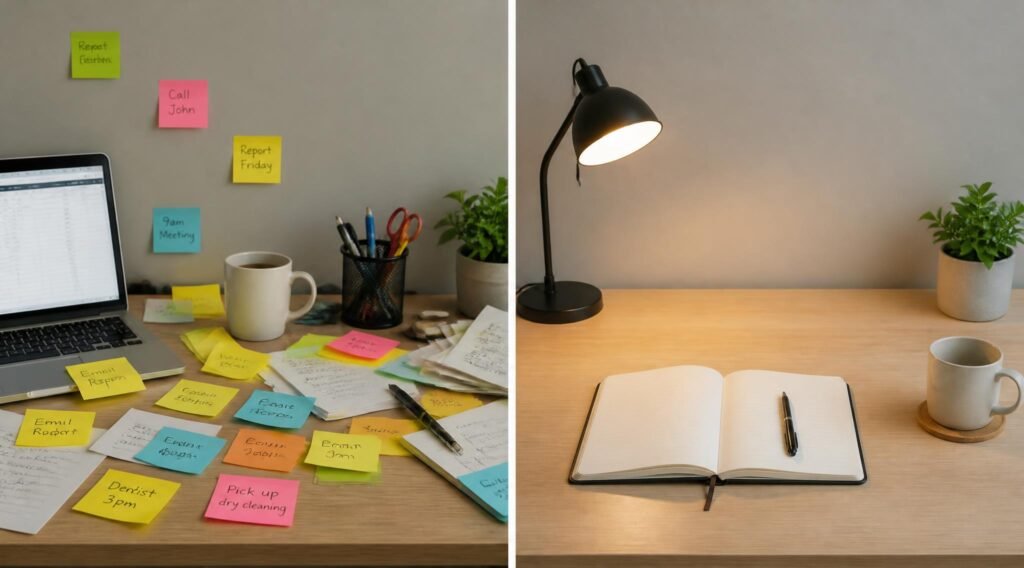
Overview: Get the loop out of your head and onto paper. Write what you’re worried about, the worst case, the most likely case, and one thing you can do. Once a thought is on the page, your brain stops working to keep it in memory.
Best for: Past replays and vague, heavy worry. Pros: ✅ Clarifies fuzzy fears ✅ Creates a record of patterns ✅ Works anywhere Cons: ❌ Can turn into more rumination if you only write the problem Our Verdict: Always end with a next step. If you like digital tools, our roundup of the best AI journaling apps shows which ones spot repeating themes, and the best planners and journals cover the analog route.
3. Switch From “Why” to “What Next”
Overview: Overthinkers ask “why” questions that have no answer: “Why am I like this?” Replace them with “what” questions: “What is one small thing I can do about this today?” The shift moves you from analysis to action.
Best for: Big decisions and work problems. Pros: ✅ Creates momentum ✅ Free ✅ Builds decision confidence Cons: ❌ Doesn’t help with problems you truly can’t act on Our Verdict: Pair it with clear goals. Our guide on how to set goals you’ll actually stick to helps you turn the “what next” answer into a plan.
4. Ground Your Body
Overview: Overthinking lives in the mind but runs on the body. Slow exhales, a cold glass of water in your hands, or naming five things you can see all pull your attention to the present moment. A calmer body makes a calmer loop.
Best for: Racing thoughts, anxiety spikes, and nighttime spirals. Pros: ✅ Works in under two minutes ✅ Can be done anywhere Cons: ❌ Doesn’t solve the underlying problem on its own Our Verdict: Use it to calm down first, then think. If you want guided practice, the best meditation apps for stress management walk you through it step by step.
5. Give Your Brain a Absorbing Task
Overview: A mind with nothing to chew on will chew on worries. Deep, absorbing work, whether a project, a puzzle, or a workout, leaves less room for the loop. This isn’t avoidance if you’ve already named the worry and set it aside.
Best for: Slow afternoons and anticipation before a big event. Pros: ✅ Productive ✅ Builds focus over time Cons: ❌ Doesn’t work if you use it to dodge a decision you need to make Our Verdict: Start with 25 focused minutes. Our guide on how to improve focus and get deep work done shows you how to protect that time.
6. Build Resilience Over Time
Overview: The more you trust yourself to handle bad outcomes, the less you need to rehearse them. Resilience is built through small, repeated experiences of coping, not through certainty about the future.
Best for: Chronic overthinkers who want long-term change. Pros: ✅ Lasting results ✅ Improves every other technique Cons: ❌ Slow, with no quick relief Our Verdict: This is the long game. Start with how to build mental resilience and revisit it monthly.
Comparison Table
| Technique | Best For | Time Needed | Difficulty | Works In The Moment? |
|---|---|---|---|---|
| Worry window | Daytime worry | 15 min/day | Easy | Partly |
| Write it out | Past replays | 10 min | Easy | Yes |
| “Why” to “What next” | Decisions | 2 min | Medium | Yes |
| Ground your body | Racing thoughts | 2 min | Easy | Yes |
| Absorbing task | Idle worry | 25+ min | Medium | Yes |
| Build resilience | Chronic patterns | Weeks | Hard | No |
Overthinking at Night, at Work, and in Relationships
The same loop shows up differently depending on where you are. Here’s how to adjust.
Overthinking at Night
Nighttime is when distractions disappear and the loop gets loudest. Keep a notebook by the bed and write down anything unresolved, then close it. Slow breathing and a wind-down routine help, and an audiobook can give your mind something gentle to follow. A consistent morning routine also supports better sleep because it anchors your day.
Overthinking at Work
At work, overthinking looks like rereading emails, delaying decisions, or perfecting things that are already good enough. Capture open loops somewhere trusted, such as one of the best AI note-taking apps, so your brain doesn’t have to hold them. Then use time blocks to decide in advance when each task gets done. If you feel flat or drained, it may be burnout rather than simple overthinking.
Overthinking in Relationships and Big Decisions
Rereading a text ten times or analyzing a friend’s tone is usually a sign of wanting certainty that no one can offer. Ask what you actually need: reassurance, a conversation, or space. Building emotional intelligence helps you name feelings instead of spiraling over them, and stronger self-confidence makes it easier to say what you need directly.
How to Stop a Spiral in 5 Minutes
Use this when you notice the loop starting. It takes about five minutes.
Step 1: Notice
Say to yourself, “I’m overthinking.” Simply noticing breaks the automatic pattern, because you’re now watching the thought instead of living inside it.
Step 2: Name the Loop
Is it a replay of the past or a rehearsal of the future? Naming the type tells you which tool to reach for.
Step 3: Breathe
Exhale slowly for six seconds, five or six times. A longer exhale than inhale signals your body that it’s safe to settle.
Step 4: Ask One Question
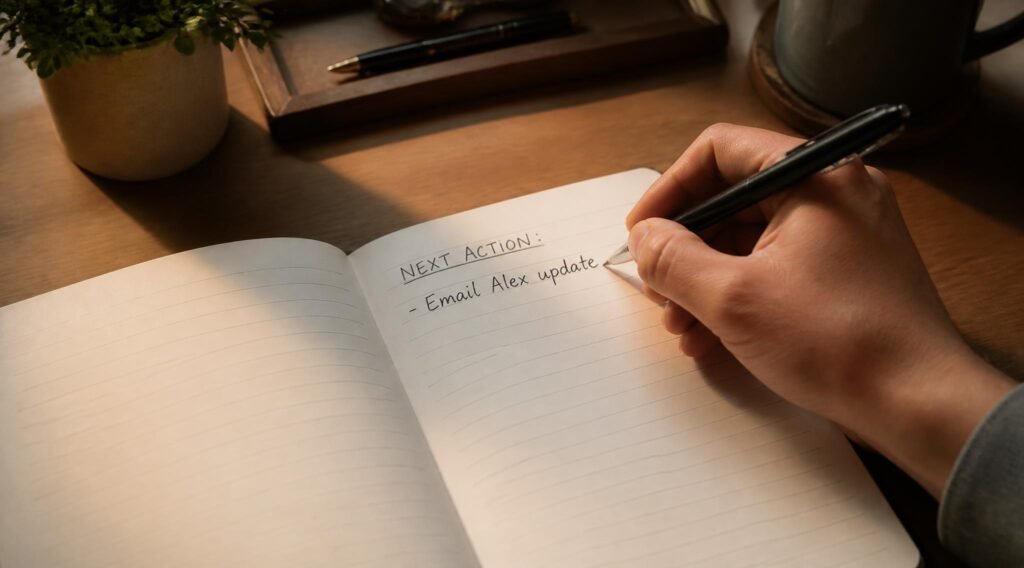
Ask, “What is the one thing I can do about this in the next 24 hours?” If there is one, write it down. If there isn’t, write, “Nothing to do right now.”
Step 5: Act or Park
Do the small action now, or schedule it. If nothing can be done, put the worry in your worry window and move your attention to something physical, like a short walk or a chore.
Common Mistakes
1. Trying to force the thought away. Pushing a thought down usually makes it return louder. Acknowledge it, then redirect. This is a skill, and it grows alongside self-discipline, so be patient with the learning curve.
2. Confusing rumination with research. Thinking about the same problem for the fifth time rarely adds new information. Set a limit, make a decision, and review the outcome later.
3. Collecting systems instead of using one. Downloading five apps and three planners becomes another form of overthinking. Pick one method and stick with it. A single habit-tracking app or a few of the daily habits that change your life in a year are plenty.
Expert Tips
Use the 10-10-10 rule. Ask how much this will matter in 10 minutes, 10 months, and 10 years. Most loops shrink immediately.
Set a decision deadline. For choices that aren’t life-changing, decide how long you’ll think about it, then choose. Extra time rarely improves the decision, but it does increase stress.
Talk to yourself like a friend. If a friend described your situation, you’d probably be kinder and more practical. Say that version out loud or write it down.

Final Thoughts
Knowing how to stop overthinking is less about silencing your mind and more about changing your relationship with your thoughts. Notice the loop, name it, calm your body, and take one small step.
- Best overall: Switching from “why” to “what next”
- Best for beginners: The worry window
- Best for nighttime: Grounding your body plus writing it out
- Best long-term: Building resilience
If you want to keep growing, explore the personal development trends shaping 2026, pick up one of the best productivity books, or read through our soft skills book list.
Frequently Asked Questions
1. Is overthinking a mental illness? No. Overthinking is a thinking pattern, not a diagnosis. However, constant uncontrollable worry can be a symptom of anxiety or depression, so if it persists, talk to a healthcare professional.
2. How long does it take to stop overthinking? Most people notice small improvements within one to two weeks of daily practice. Lasting change usually takes a few months, because you’re retraining a habit.
3. What’s the difference between overthinking and problem solving? Problem solving moves toward a decision or action. Overthinking repeats the same thoughts without new information. If you’re not getting closer to an answer, you’re probably overthinking.
4. Why do I overthink everything at night? At night there are fewer distractions, and tiredness lowers your ability to regulate emotions. Writing down open loops before bed and using slow breathing can help.
5. Can journaling really help me stop overthinking? Yes, when you include a next step. Writing externalizes the thought so your brain doesn’t have to keep rehearsing it. Writing only the problem can make rumination worse.
6. Do I need an app to stop overthinking? No. A notebook, a timer, and slow breathing are enough. Apps can help with reminders and structure, but they aren’t required.
7. Does noise or music help? For some people, yes. Calm, familiar sounds can reduce mental chatter, and noise-cancelling headphones can help in noisy spaces.
8. Is overthinking the same as being a perfectionist? They’re related but not identical. Perfectionism sets very high standards, and overthinking is the repetitive mental loop that often follows. Many perfectionists overthink because they fear mistakes.
9. When should I see a professional? See a professional if overthinking lasts for weeks, disrupts sleep or daily life, or comes with intense anxiety or low mood. A therapist can teach proven methods tailored to you.
Author: Jhon Last Updated: October 2026